| Mike Sullivan (and Related) Citation Archive on Genesis Creation Issues
October 4, 2026
"The reason that Genesis 1 has been understood as material for so long is because our world has been so entrenched in a material ontology that it cannot think that there is even another possibility."
-Dr. John H. Walton
Video Clip: Mike Sullivan on "Heavens and Earth" of Genesis 1 as Covenant?
Video Clip: Mike Sullivan Commends John Walton's work on Genesis Creation.
Video Clip: Mike Sullivan Trailblazes Adam as "The First Covenant Man."
"I do NOT make Genesis issues a test of fellowship and I try and approach the subject with some humility since I still have a lot to work through."
-Mike Sullivan, "TEMPLE THEOLOGY AND IMAGERY OF GENESIS 1-4 TO REVELATION 21-22"
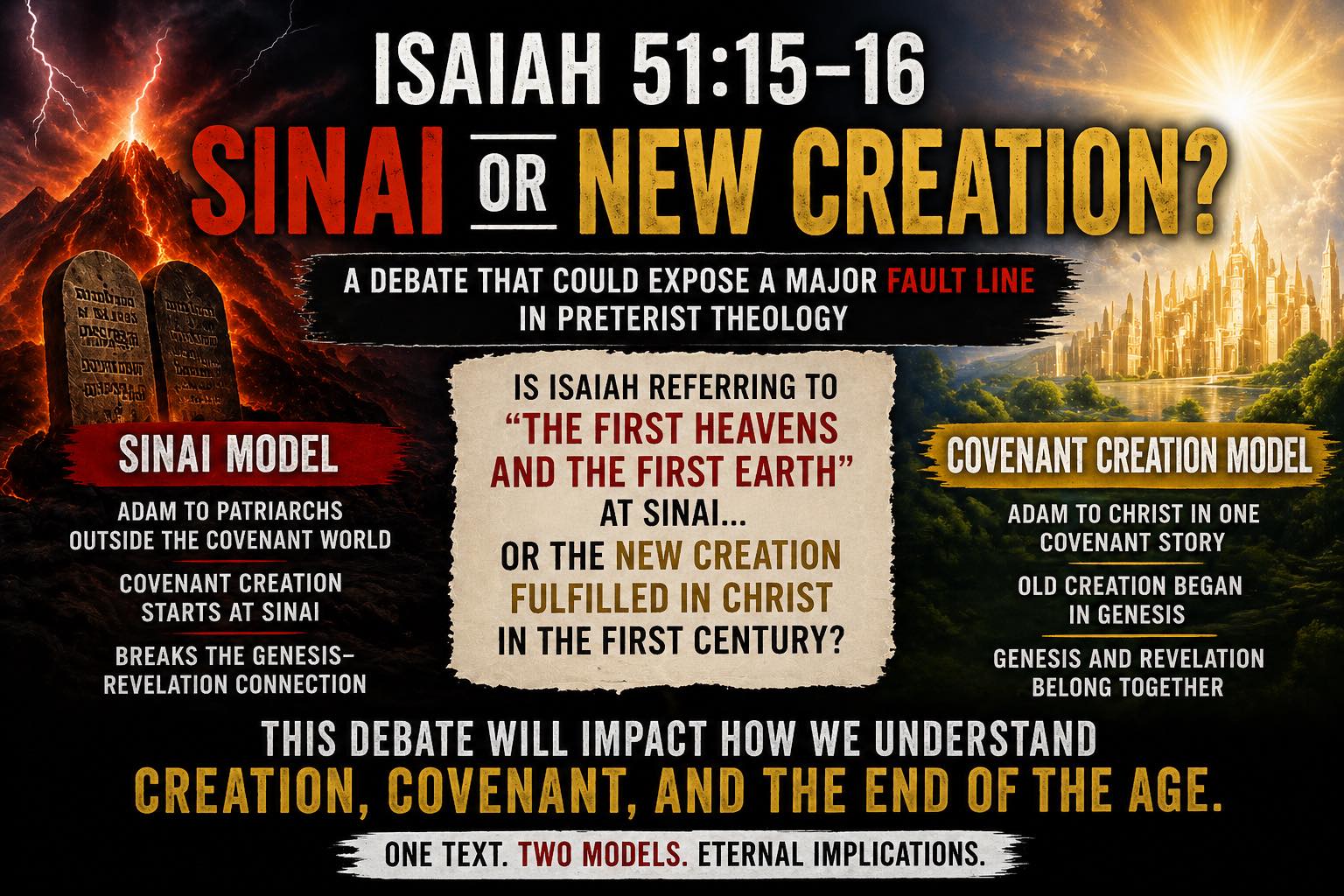
The Isaiah 51 Sullivan V. Martin Debate of 2026
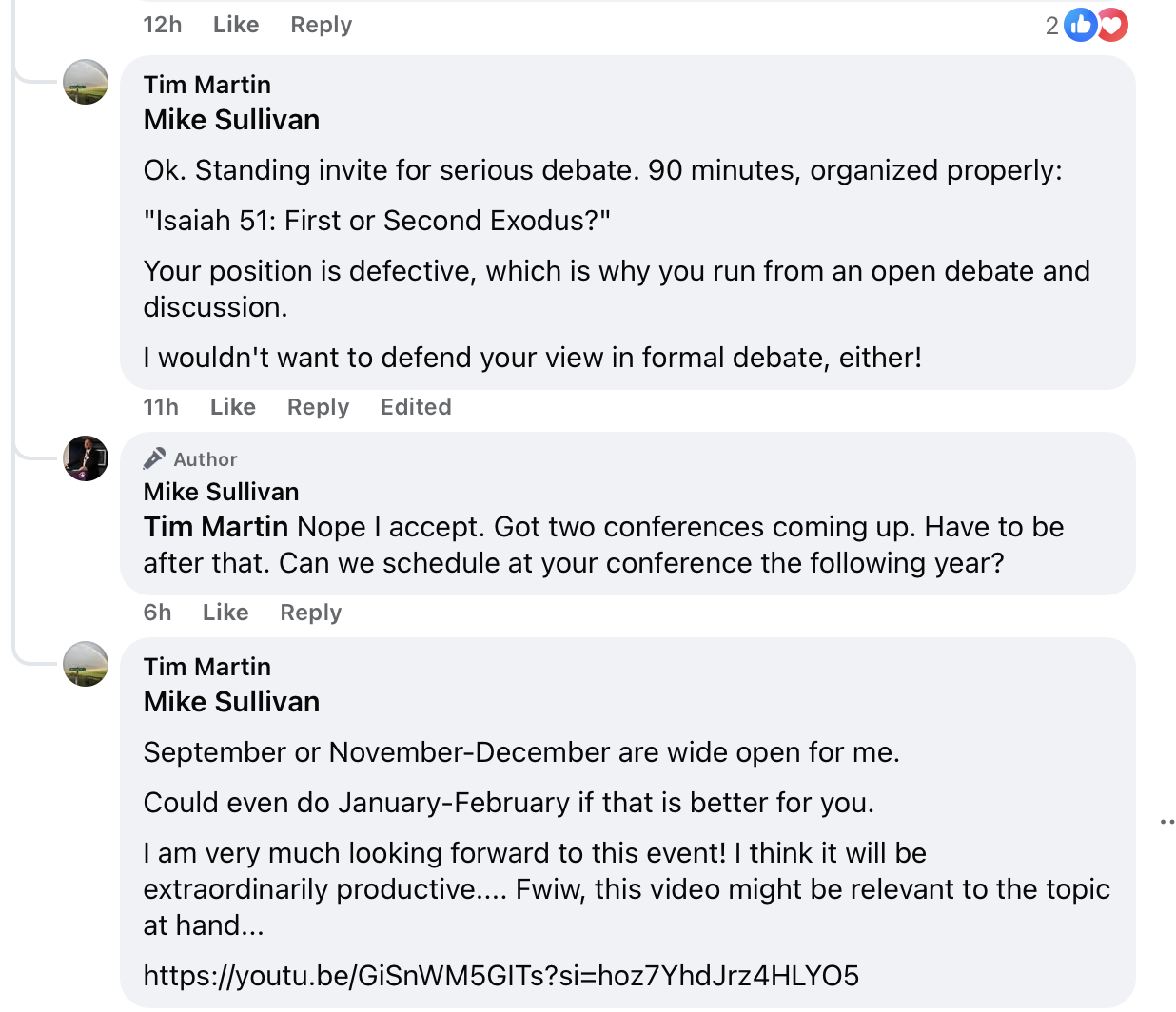
Full Archive of Related Debate Material
Mike Sullivan Cancels the Debate
Tim Martin Responds
Jack Scott on Isaiah 51:15-16 in Covenant Context
A Postmortem: Isaiah 51 Debate Challenge Gets Results!
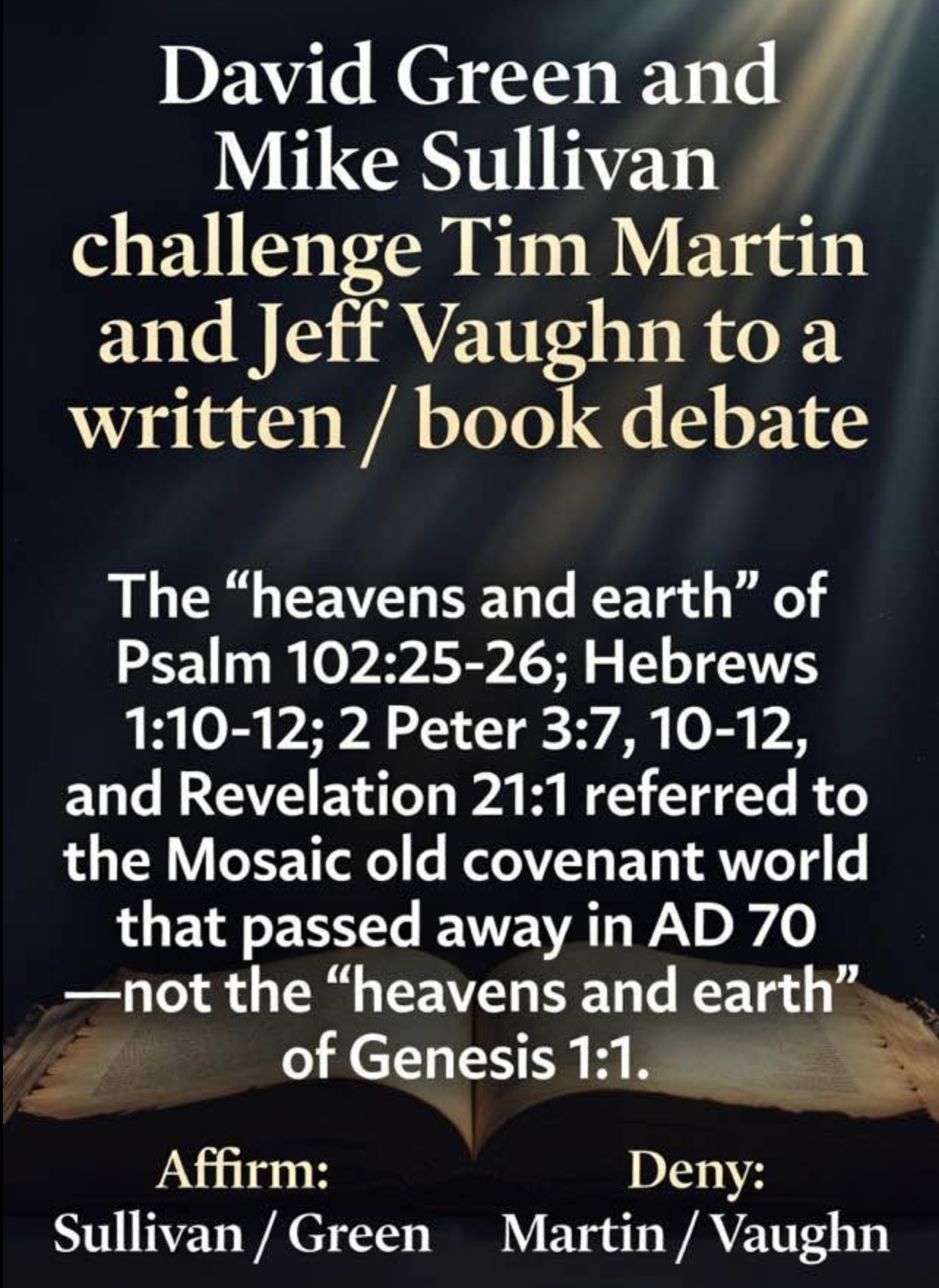
Counter-Debate Challenge (Sullivan/Green) of July - 2026
"Hey guys,
I'm going to stick to the proposition below for the following reasons:
(1). Prior to you two, there were NO full preterists teaching the "heavens and earth" of Gen. 1:1 are the subject of the NT de-creation texts in the proposition. Therefore, the burden of proof is upon you to prove such and should be front and center in the proposition...."
Really?!? You be the judge...
"The sign of the earthquake throughout the book of Revelation denotes the shaking and removal of the old covenant world. The earthquake at Mount Sinai was a type of the greater and final “shaking” of heaven and earth that was going to take place in Christ’s generation (Matt. 24:29, 34; Mk. 13:25, 30; Lk. 21:26, 32). This was not a literal shaking of the stars and planets. It was the “shaking” of the historic, Adamic system of Sin and Death in God’s kingdom (Hebrews 12:25-28)." (emphasis mine)
-Mike Sullivan, House Divided: Bridging the Gap in Reformed Eschatology (2013), p. 155. [With authors David Green and Edward Hassert]
Video Clip: Don Preston shows AD70 Brings the End of the Adamic Age and Adamic Death.
"The first-fruits church, through the indwelling Spirit of the reigning Christ, was putting to death the Adamic world-body of Death itself (alienation from the Father) through the newly-revealed gospel of God. Through the Death-destroying, Life-giving, “man”-changing power of the gospel of the death and resurrection of Christ, the fleshly, Adamic “man” or “body” or “creation” — the whole world-system of the dominion of Sin and Death — was being put to death and “abolished.” It was that body which would soon be raised up and “changed” (in AD 70) into the new, Christological, spiritual “body” in the kingdom of God (the new covenant world)."
-David Green, House Divided: Bridging the Gap in Reformed Eschatology (2013), p. 216 [with authors Mike Sullivan and Ed Hassert].
"The Universal Change (1 Cor. 15:51-58)
The coming transformation of God’s covenant-universe (dead and living, Jew and Gentile) through the gospel of the death and resurrection of the body of Christ was the “mystery” that had been kept secret since the world began"....
The world-change, or body-change, took place and the “mystery” was fulfilled before Paul’s generation passed away (1 Cor 15:51). The sounding of the symbolic “last trumpet”took place when the worldly city and sanctuary fell in AD 70 (Rev. 10:7; 11:2, 8; cf. Heb. 9:8). When that old “house” fell and the old Adamic “garment” was folded up and “changed,” the dead were raised and all the elect were “clothed” with the body of Christ in the new covenant world (Heb. 1:10–12).
[T.M. Note Adamic Context for Hebrews 1:10-12!!!!!!]
-David Green, House Divided: Bridging the Gap in Reformed Eschatology (2013), p. 222 [with authors Mike Sullivan and Ed Hassert].
“The saints in Christ today have a higher point of origin and a higher identity than the saints had in Adam.
Because God’s faithful ones are now reconciled to Him in one body in the new covenant world, neither their life nor their labors in Christ begin or end in “dust” or futility or defeat. God’s covenant-creation (the world of His people) has been set free from the Adamic bondage of the futility that God imposed upon it in Genesis 3:17-19 (Rom. 8:20).”
-David Green, House Divided: Bridging the Gap in Reformed Eschatology (2013), p. 183. [With authors Mike Sullivan and Edward Hassert]
[Editor's Note: Please see this presentation at Covenant Creation on YouTube that develops the implications here: "Dust to Kingship"]
"The heavens and the earth" referred to the pre-Messianic, dead-in-Sin world of God's people. That old creation or cosmos was dissolved, and it vanished shortly after Peter wrote his epistles, in AD 70....
As we will discuss in more detail below, since the consummated death of the Adamic, old covenant "man" in AD70, the universal church is now and forever the resurrected, living, and "spiritual body" of Christ."
-David Green, House Divided: Bridging the Gap in Reformed Eschatology (2013), pp. 173, 175-176. [With authors Mike Sullivan and Edward Hassert].
The resurrection-of-the-dead deniers [in 1 Cor. 15] thought that the eschatological church was an altogether separate entity from the Adamic, old covenant world. They thought that the body of Christ essentially appeared out of nowhere, as it were, absolutely disconnected from the world that preceded it....
Before Christ, the saints bore the image of Adam, the disobedient one....
Paul's answer (verses 36-37):
"The dead are being raised through the burial and death of the body of Sin, of which we are still a part (since the old covenant world had not yet vanished). The dead, therefore, are being raised through out (the last day, first-fruit church's) dying to Sin (the burial and death of the Adamic 'body' with Christ) on their behalf, and they will therefoe be 'changed' with us into the resurrected, spiritual body of Christ in the new covenant world.
-David Green, House Divided: Bridging the Gap in Reformed Eschatology (2013), p. 218-220. [With authors Mike Sullivan and Edward Hassert].
Mike Sullivan Responds (Part 2)
Tim Martin Responds (Part 2)
Mike Sullivan Citations from Various Articles (emphasis mine)
The “restoration of all things” that occurred when Christ was revealed from heaven in AD 70 had to do with the turning of the hearts of Israel and the Gentile nations back to God. This was the Spirit empowered “mystery” that was taking place between AD 30 – AD 70. The “creation” (Greek kitisis) “groaning” and “about to” (Greek mello) to be liberated in (Romans 8:18-23 YLT) was the “creation” (Greek kitisis) Paul had preached the gospel to throughout the then known world (Cols. 1:5-6, 23). This was the creation of men, and had nothing to do with rocks, trees, bugs, slugs or squirrels longing for a day they wouldn’t get hit by cars."
-Mike Sullivan, "Peter And The “Restoration Of All Things” Parts 1: Cosmic Geography And Peter Son Of JONAH’S Mission (Acts 1-3; 9-11) Fulfilled By AD 70. Part 2: 1-2 Peter and the Restoration of Genesis 1-3"
Video Clip: Mike Sullivan on "Heavens and Earth" of Genesis 1 as Covenant!!!
In Mathison’s section on the “Restoration of Creation” (WSTTB? 195–197), he appeals to the literal and global beginnings of Genesis 1–3 to point out that preterists have interpreted “the end” in Romans 8 and in the rest of the New Testament in an inaccurate way. But Mathison and other Postmillennialists should be open to considering the interpretations of Genesis 1–3 that are presented by some within the Reformed tradition and by other futurists.
Combined, authors such as Augustine, Milton Terry, David Snoke, Meredith Kline, and dispensationalist John Sailhamer teach the following concepts:
- The days are not literal 24 hour days.
- Man was created a physical dying creature like all the plant and animal life around him.
- The physics of the creation did not change after Adam.
- Genesis 1–2 uses the Hebrew word eretz, which should be translated as “land” or “ground” and not [planet] “earth.”
- God’s emphases in the early chapters of Genesis are not scientific but theological, emphasizing the origins of sin in the heart and man’s need for the Seed of the woman to redeem him from Sin.
As the theological emphasis in Genesis 1–2 is on the local land of Eden, which is both theologically and geographically tied to Israel’s Promised Land, so too is the emphasis of the New Testament on a Great Commission preached to the nations of Israel and to the Roman Empire with a judgment that would affect the nations of that world.
-Mike Sullivan, "My Second Lecture at the PPW 2017 Conference Problems for Postmillennialism in the Olivet Discourse (Resurrection Cont.) Part 5 the “Redemption” and “Redemption of the Body” (Luke 21:27-28 = Romans 8:18-23YLT)"
Jesus connects the wickedness of His contemporary generation for rejecting Him with the days of Noah in Luke 17:25-28. As far as comparing a global flood with a global Great Tribulation period coming in our generation I have only two brief points. First, I believe the Bible teaches a local flood and not a global flood (and time restraints will not allow be to develop this).
-Mike Sullivan, "CHRISTIAN" DISPENSATIONAL ZIONISM AND JOHN HAGEE'S 10 SIGNS REFUTED – ALL THE PROMISES OF GOD FULFILLED "IN CHRIST" NOT "IN THE LAND"!
[Editor's Note: Please see Beyond Creation Science chapters 6-10 on why Preterism refutes global flood doctrine. The book is available for free instant access here.]
The “salvation” and “redemption” associated with Christ’s Second Coming in AD 70 entailed much more than a physical flight to the wilderness of Pella, as some commentators have proposed. Christ’s Parousia in AD 70 was a redemptive and soteriological event that occurred “in” and “within” the minds, consciences and hearts of the Church, when God consumed by fire the Adamic world of Satan, Sin, Death and Condemnation, consummately purging His church of sin through the Cross of Christ (Rom. 8:18-23; 11:26-27; 13:11-12; Heb. 8-10). The “redemption” of Luke 21:28 is the “redemption of the body” in Romans 8:18-23. Both the imminence of the time texts and the spiritual nature of their fulfillment require this interpretation.
-Mike Sullivan, "House Divided: Imminent Redemption in Luke 21:27-28 / Romans 8:18-23 and The Analogy of Scripture"
Adam is pictured as the High Priest of Israel going into the MHP “presence of the Lord” to be tested and commissioned to pray, worship, and offer up the sacrifice in the “cool of the day. When the Priest would go into the Sanctuary to offer up sacrifices to God on behalf of the people, they would tie a rope around his ankle in case his heart was not right and God struck him down dead in His presence. In this way Adam is seen as failing the test and God is now driving (dragging him out) of His presence from the HP and MHP of the Garden sanctuary. In the “dust” of this area Adam would be called to labor verses worship, and it would be “increased” through the sweat of his brow in the same way that Eve’s labor pain would be. This is not a proof text that this was the first time a weed, a thorn or pain for Eve was ever present in creation let alone outside the Garden where the “dust” was. The hardness of the ground and the toil and work involved here is communicating the result of the spiritual death, shame, and guilt infused upon the heart and conscience of Adam after he sinned.
-Mike Sullivan, "TEMPLE THEOLOGY AND IMAGERY OF GENESIS 1-4 TO REVELATION 21-22"
[Editor's Note: Please see this video from the 2024 Covenant Creation Curriculum Series - "Thorns and Thistles"]
Moses creation account (given through the direct revelation of God) serves as a theistic apologetic to the surrounding enemies and nations of Israel. Another apologetic of Moses is his use of the genealogies of Israel tracing them them back to Adam – the first covenantal man in their land. This communicates that they not only have a direct commission by Jehovah to inherit the land, but they have a legal right through decent as well.
-Mike Sullivan, "TEMPLE THEOLOGY AND IMAGERY OF GENESIS 1-4 TO REVELATION 21-22"
Video Clip: Mike Sullivan Pioneers Adam as "The First Covenant Man"
I have toyed with the concept of Adam being the first covenant man instead of the first man ever to exist for well over 25 years. It is an argument from silence but a very LOUD one that the civilization of "Nod" just pops up out of nowhere in the early chapters of Genesis. The land of Eden (described in Temple imagery) is marked off by the same area as Israel's promised land. Beale informs us that the Jew considered his land, city and temple as "heaven and earth." Is it possible that Israel's genealogies going back to Adam are designed to prove Israel has a covenantal right to this land because they originally came from it?....
Is it possible that the first "heaven and earth" in Genesis 1-2 and Israel's covenant "heaven and earth" (Isa. 51:15-16) involved literal "sacred space" but once we get to the NT the new covenant "heavens and earth" are God's people that are His sacred space "New Jerusalem"/"Heaven and Earth" - of which the Gentile nations come to for the light of the Gospel to be healed?
Clearly Paul's contrast between Adam and Christ is not a biological contrast, but a covenant contrast. Just as Paul's appeals to "flesh" and "spirit" in Romans 5-8 is not a biological issue as much as it is -- whose covenant headship are you under - "in Adam/Moses" = flesh or "in Christ" new covenant of Spirit.
I personally believe elements of the Day Age and Frame Work views better support the exegesis of what the new-testament teaches concerning the “restoration of creation.” As the theological emphasis on (Gen.1-2) is on the local land of Eden which is both theologically and geographically tied to Israel’s Promised Land and the “earth/land” of their surrounding civilizations or nations (Nod, Babel, Babylon Assyria, etc.); so too is the emphasis and development of the new-testament being a great commission preached to the nations of Israel and the Roman Empire with a localized judgment affecting the nations of the those worlds by A.D. 70.
-Mike Sullivan, "TEMPLE THEOLOGY AND IMAGERY OF GENESIS 1-4 TO REVELATION 21-22"
Most Futurists assume that the fall of Adam affected more than man’s heart and conscience, in that it brought about physical death, pain, suffering, and decay for the entire globe. Until a successful global great commission of the planet’s nations has been achieved in putting down all of God’s enemies and physical death and pain have been completely eliminated, Christ’s return and the new creation cannot be said to have come in their fullness. However, as we will see, these Futurist propositions are not exegetically sound. I will be refuting these Futurist presuppositions using a corporate covenantal view of redemption using temple imagery from Genesis to Revelation. My primary emphasis and motifs through using this structure will be on developing two main themes: 1) Death and life through Adam, Israel and Christ and 2) the Great Commission being fulfilled and preached “every nation and creature under heaven” and throughout the entire “world” by AD 70.
-Mike Sullivan, "TEMPLE THEOLOGY AND IMAGERY OF GENESIS 1-4 TO REVELATION 21-22"
Video Clip: Mike Sullivan Shows the Image of God is "Spiritual"
God’s creation and maturing of His new heavens and new earth arrived with the imminent return of Christ to end the “last days” of the old covenant age in AD 70 – according to (2 Peter 3 – being a “reminder” of 1 Peter 1:4-12; 4:5-7, 17 and Revelation 21-22: 6-7, 10-12, 20). This is when the curse of the Adamic and Mosaic “the law,” “the sin,” and “the death,” creation was “about to be” completely removed for the Church (Romans 5-8).
-Mike Sullivan, "The Truth About Isaiah 65:17-25"
Paul and the first century churches temporary eschatological “labour” (pains, persecutions in preaching the gospel, and groaning under “the death” of Adamic sin), were not in vain (1 Cor. 15:58; Romans 5-8; Gal. 4:19; 2 Cor. 3-5:5).
-Mike Sullivan, "The Truth About Isaiah 65:17-25"
Older commentators understood these peaceful animal passages such as (Isaiah 11:6-9) to be a description of the peace the gospel produces among men – Jew and Gentile. They had it right! But because of their futurism and faulty presuppositions in Genesis, they also were forced into literalizing these passage of literal animals with “ongoing,” “physical phases,” when God’s creation would be finally restored.
The passage has nothing to do with “lion tamers” or lions becoming vegetarians as an ongoing reversal of the physical effects of the fall.
Beloved, do not be deceived, Postmillennial Partial Preterism is not Biblical Preterism. It is carnal futurism both in the timing and nature of fulfillment – plain and simple. The “first” heavens and earth have passed away, the new is here, the healing of the nations is taking place, and it won’t be realized in an “not yet” of 900 year old naked men (fig leaves were a “physical effect” of Adam’s sin – right?) running around taming vegetarian lions and watching their children playing with poisonous snakes!
-Mike Sullivan, "The Truth About Isaiah 65:17-25"
[Editor's Note: Please see this video from the 2024 Covenant Creation Curriculum Series - "Covenant Population and the Animals]
Genesis 1 – 3 and the “Restoration of Creation” Motif
Keith Mathison in his book (When Shall These Things Be?) seeking to refute Biblical Preterism does not inform his audience of the different reformed views of the creation account in the early chapters of Genesis; but simply plugs in his personal presuppositions and shallow exegesis of Genesis 1-3 into such texts as Isaiah 64-66; Romans 8; 2 Peter 3; and Revelation 21-22. He simply assumes that at a future second coming the curse of Adam’s physical death and decay which allegedly has been passed down upon all mankind and animal life will one day be “restored” to a state of non-biological death and decay. Mathison believes that any futuristic paradigm (even Dispensationalism) is to be preferred over the “Hyper-Preterist” view when it comes to “the end” in (Mt. 24-25; I Cor. 15; & Revelation). Therefore, according to Mathison’s logic he and his readers should equally be open to considering some developments of the “beginning” in (Gen. 1-3) from those within his reformed tradition and other futurists (including Dispensationalists).
Here is a list of combined admissions from reformed and dispensational theologians that unravel Mathison’s presuppositions in Genesis and of which I feel better fit a Full Preterist interpretation and emphasis of what the “restoration of creation” is as seen through the NT. I will focus on the views held by Augustine, Milton Terry, the Day Age view (David Snoke), the Framework view (Meredith Kline), John Sailhmaer and John Walton. These combined admissions and concepts build the following paradigm:
1). The 7 days of creation and the Sabbath rest of God in (Gen.1-2) are not literal 24 hour days but symbolic and figurative. Augustine argued this position 14 centuries before Darwin and evolution was ever an issue. In other words his concerns were exegetical and no one was accusing him of being a liberal or evolutionist for making his exegesis! He argued that there cannot be three 24 hour days without the creation of the sun and solar system which were created on the fourth day. Building upon Augustines exegesis, reformed theologian Meredith G. Kline has likewise argued that the days are not 24 hour days set forth in perfect chronological and sequential order, but rather are described with Hebrew parallelism using Sabbatical symbolism…..
Kline is also in agreement with reformed Day Age advocates that Scripture teaches prior to the fall of Adam, animals were carnivorous, died, and that apart of man’s dominion over them was that he could kill them for warmth and food.
-Mike Sullivan, "TEMPLE THEOLOGY AND IMAGERY OF GENESIS 1-4 TO REVELATION 21-22"
See Beyond Creation Science for a full Covenant Creation Model here
The Hebrew communicates that the state of the land of Eden in (Gen.1:2) would better be translated as “uninhabitable,” “inhospitable,” or “wilderness” as was the wilderness area Israel wandered in for forty years before inheriting the promised land (Sailhamer, ibid., pp. 63-66). These are excellent observations and I would add that when Israel broke law in the promised land God was able to turn her land back into a wilderness (Deut.28) using (Gen.1:2) as a creation/de-creation referent, “I beheld the earth (better translated – “land”), and indeed it was without form, and void; And the heavens, they had no light.
-Mike Sullivan, "TEMPLE THEOLOGY AND IMAGERY OF GENESIS 1-4 TO REVELATION 21-22"
[Editor's Note: Please see Tim Martin's 2026 Conference Presentation titled "The Faith at the Field of Anathoth"
And I don’t think Snoke is “going too far” in seeing Eve’s labor pains being “increased” as “symbolic” with the world “groaning” in (Rms. 8). But as Snoke points out the story of redemption involves Christ dieing for men not giving eternal life to animals and trees (Old Earth, p.64). Therefore, the world or intelligible creation (Gk. kistisis) of men under sin through Adam in (Rms.8) definitely groan and experience “futility” and “vanity” (cf. ecl.) apart from Christ. However, when it come to groaning in labor pains, I see the symbolism more with Israel “groaning” under the yoke of Torah and in labor pain never able to produce Gentile children/converts into the kingdom (Isa.26:17-18) whereas the Church did and continues today in the new covenant age.
-Mike Sullivan, "TEMPLE THEOLOGY AND IMAGERY OF GENESIS 1-4 TO REVELATION 21-22"
Cain killed Abel at the entrance of the Garden under the “altar” which was as close to the Garden/Sancturary to offer up sacrifices as they could get. “Under the altar” is where all of the martyrs from Abel to the New-Testament Apostles and Prophets would be until God would vindicate and reward them with entrance into the New Creation in Jesus’ “this generation” and in an A.D. 70 “little while” and “soon” time frame (Mt.23:30-36; Rev.6:9-11; Rev.20; 22:12/Mt.16:27-28).
-Mike Sullivan, "TEMPLE THEOLOGY AND IMAGERY OF GENESIS 1-4 TO REVELATION 21-22"
Sticking with the temple imagery in (Gen.1-4), Cain is banished even further eastward than Adam to live outside the Land of Eden altogether into the Outter-Court of the Gentiles. He is banished to live among the people of Nod (Gen.4). There of course has been controversy within various theological views over who the people and civilization of Nod were. Were these people the products of incestuous relations between the offspring of Adam and Eve before the gene pool got contaminated? If not, was this a contemporary people and civilization living during the time of Adam and his clan to whom he had a commission to?
No matter how one answers these questions, it is irrelevant to the theological point of the text. That being, when one dies spiritually he continues on a journey (pictured eastward) into futility, fear, and bondage outside of God’s land/presence into the death and darkness of being in the outer-court of the gentiles. The ancient city of Babel also resided eastward, in the out-court of Eden as the enslaving power of Babylon lay in the out-court of Israel’s Promised Land.
-Mike Sullivan, "TEMPLE THEOLOGY AND IMAGERY OF GENESIS 1-4 TO REVELATION 21-22"
Editor's Note: These two presentations offer a biblical case for Adam as the First Covenant Man:
2009 Covenant Creation Conference #6: From Darkness to Light by Mickey Denen
Adam Outside the Garden by William Bell
Part 4 of the 2024 Covenant Creation Curriculum Series
Harmonizing the Theology and Imagery of Genesis 1-3 with Revelation 21-22 and Bringing Man Into The Kingdom Of Heaven or the Most Holy Place Presence of God
In evaluating some of the most important thinkers within the development of reformed and dispensational theology on the early chapters of Genesis, we get the following results which help develop what the NT teaches concerning the new creation and unravels Futurist presuppositions of Genesis 1-3. Let’s look at some of these Futurist concepts and then apply them to a proper Full Preterist paradigm — as it pertains to how the NT develops the corporate body / temple and individual body / temple concepts and how God uses these concepts to describe His relationship with us.
1). The 7 days of creation are not literal 24 hour chronological days, but written in: a) symbolic, b) sabbatical, c) covenantal, d) with Hebrew parallelism and recapitulation, and contain genre of e) allegory, metaphor, and apocalyptic language.
2) Before Adam sinned there was biological death, pain, and decay of plant and animal life – which included Adam. The laws of physics have not changed pre-fall or after Adam’s sin.
3) The narration and theological emphasis of Adam’s fall communicates “a philosopheme—a vivid pictorial representation of the origin and growth of sin in the human heart.” And “We behold in symbolic outline the development of the sense of guilt in the human conscience.”
4) The theological emphasis of the temple cosmology of (Gen.1-2) is the local Land (Hebrew eretz) of Eden which is theologically and geographically connected to Israel’s Promised Land.
5) Moses creation account (given through the direct revelation of God) serves as a theistic apologetic to the surrounding enemies and nations of Israel. Another apologetic of Moses is his use of the genealogies of Israel tracing them them back to Adam – the first covenantal man in their land. This communicates that they not only have a direct commission by Jehovah to inherit the land, but they have a legal right through decent as well.
6) I would agree with Kline in seeing Adam as a real historical figure and not a “myth.” Jesus is described as the New Creation within another 7 day picture in John’s prologue to his gospel (Jn.1-4) which is arranged topically to communicate this New Creation motif. This of course does not mean that Adam was described as a “myth” anymore than Jesus was.
-Mike Sullivan, "TEMPLE THEOLOGY AND IMAGERY OF GENESIS 1-4 TO REVELATION 21-22"
In the Jewish mind however, God’s creation of the heavens and earth/land in (Gen.1-2) and (Isa.51:15-16) were not completed until God had created the “heavens and earth/land” of the tabernacle and God’s presence rested in the midst of them,
“When, however, the Tabernacle was set up and the Holy One, blessed be He, caused the Shecinah to rest within it, He said, “Let it be written that on this day the world was created”’ (Num. R. x111. 6). The implication seems to be that until the Shechinah took up its abode among men through the erection of the Sanctuary, the world could not really be said to exist in the full sense of the term.”
This seems to support John Walton’s understanding of the ancient mind, in that, something doesn’t truly exist until it has a “functional” meaning to the covenant community.
-Mike Sullivan, "TEMPLE THEOLOGY AND IMAGERY OF GENESIS 1-4 TO REVELATION 21-22"
[Editor's Note: Please see Covenant Creation YouTube Video titled "Is Covenant Creation Just Plain Crazy?"]
The Second coming or Day of the Lord has arrived and there is no more darkness [Genesis 1] in this eternal day of the kingdom. There are no more holy days for everyday is a Sabbath and celebration in God’s Kingdom under the new creation.
-Mike Sullivan, "TEMPLE THEOLOGY AND IMAGERY OF GENESIS 1-4 TO REVELATION 21-22"
[Editor's Note: Please see Tim Martin's 2025 Conference Presentation titled "The Biblical Theology of the First and the Second"]
God chose Israel (a corporate Adam) to be His elect son and commissioned him to now subdue (Hebrew kabash) the wicked nations of the land (Num. 32:29; 2 Sam. 8:11; 1 Chron. 22:18-19) and to have dominion (Hebrew radah) (rule, reign, possess, plunder, & make slaves of) the other nations of the land (Lev. 25:44-46; 1 Kings 4:21-25; Isa.14:2). Under the old-covenant God primarily dealt with His chosen Nation Israel and His purpose among the Nations was to drive them out and exterminate them and their idols from His Land (Deut.6-7). The Jewish mindset considered the Promised Land of Israel with its Holy City and temple to be the Garden of God and where the light and life of Torah resided. They considered the heathen Gentile Nations to be dogs and wild beasts of the field in utter darkness and death needing to be re-created and subdued under the teaching of Torah.
-Mike Sullivan, "TEMPLE THEOLOGY AND IMAGERY OF GENESIS 1-4 TO REVELATION 21-22"
Editor's Note: Please see Covenant Creation YouTube Video titled "Israel and Adam... Creation as 'Old Covenant' is THE BIG DANCE"]
The early chapters of Genesis were never meant to be interpreted with a hyper-literal hermeneutic and nor should they be viewed through the lens of science. From Genesis to Revelation we have a story of God’s redemptive plan whereby His goal is to overcome spiritual death and separation and abide with His people forever through faith in His Son.
Adam’s story is Israel’s story...
-Mike Sullivan, "TEMPLE THEOLOGY AND IMAGERY OF GENESIS 1-4 TO REVELATION 21-22"
Our focus in Part 1 was to develop Acts 1-3; 9-11 and Peter’s eschatology in how the “restoration of all things” in Genesis 10-12/Deuteronomy 32:8-9 would be fulfilled at the Second Coming of Christ in AD 70. The curse of Babel and the table of nations was reversed through the GC of Acts 1:8 being fulfilled by AD 70.
Now I would like to examine Peter’s eschatology in 1-2 Peter and how the Adamic world of Genesis 1-3 and Israel was being restored and would fully be restored and transformed at Christ’s “near” Parousia in AD 70.
-Mike Sullivan, "Peter And The “Restoration Of All Things” Parts 1: Cosmic Geography And Peter Son Of JONAH’S Mission (Acts 1-3; 9-11) Fulfilled By AD 70. Part 2: 1-2 Peter and the Restoration of Genesis 1-3"
Citations Related to Genesis Creation in House Divided (2013)
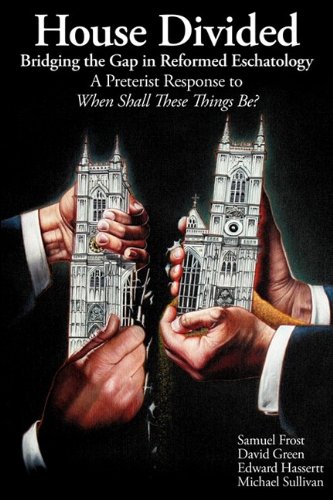
For Paul, Sin had produced "death," but not physical death. Contrary to Mathison's assertions, "the body," "death," and "the flesh" in Romans 5-8 have nothing to do with the idea of men biologically dying as a result of Adam's sin.
-Mike Sullivan, House Divided: Bridging the Gap in Reformed Eschatology (2013), p. 118. [With authors David Green and Edward Hassert]
In Mathison’s section on the “Restoration of Creation” (195–197), he appeals to the literal and global beginnings of Genesis 1–3 to point out that preterists have interpreted “the end” in Romans 8 and in the rest of the New Testament in an inaccurate way. But Mathison should be open to considering the interpretations of Genesis 1–3 that are presented by some within the Reformed tradition and by other futurists.
Combined, authors such as Augustine, Milton Terry, David Snoke, Meredith Kline, and dispensationalist John Sailhamer teach the following concepts:
- Man was created a physical dying creature like all the plant and animal life around him.
- The physics of the creation did not change after Adam sinned.
- Genesis 1–2 uses the Hebrew word eretz, which should be translated as “land” or “ground” and not [planet] “earth.”
- God’s emphases in the early chapters of Genesis are not scientific but theological, emphasizing the origins of sin in the heart and man’s need for the Seed of the woman to redeem him from Sin.
As the theological emphasis in Genesis 1–2 is on the local land of Eden, which is both theologically and geographically tied to Israel’s Promised Land, so too is the emphasis of the New Testament on a Great Commission preached to the nations of Israel and to the Roman Empire with a judgment that would affect the nations of that world.
-Mike Sullivan, House Divided: Bridging the Gap in Reformed Eschatology (2013), pp. 121-122. [With authors David Green and Edward Hassert].
"The Death" that came through Adam the very day he sinned was spiritual and not biological.... The abolition of biological death was never the purpose of Christ's redemptive work.
-Mike Sullivan, House Divided: Bridging the Gap in Reformed Eschatology (2013), p. 124. [With authors David Green and Edward Hassert]
"The sign of the earthquake throughout the book of Revelation denotes the shaking and removal of the old covenant world. The earthquake at Mount Sinai was a type of the greater and final “shaking” of heaven and earth that was going to take place in Christ’s generation (Matt. 24:29, 34; Mk. 13:25, 30; Lk. 21:26, 32). This was not a literal shaking of the stars and planets. It was the “shaking” of the historic, Adamic system of Sin and Death in God’s kingdom (Hebrews 12:25-28)." (emphasis mine)
-Mike Sullivan, House Divided: Bridging the Gap in Reformed Eschatology (2013), p. 155. [With authors David Green and Edward Hassert]
"The heavens and the earth" referred to the pre-Messianic, dead-in-Sin world of God's people. That old creation or cosmos was dissolved, and it vanished shortly after Peter wrote his epistles, in AD 70....
As we will discuss in more detail below, since the consummated death of the Adamic, old covenant "man" in AD70, the universal church is now and forever the resurrected, living, and "spiritual body" of Christ."
-David Green, House Divided: Bridging the Gap in Reformed Eschatology (2013), pp. 173, 175-176. [With authors Mike Sullivan and Ed Hassert].
The saints in Christ today have a higher point of origin and a higher identity than the saints had in Adam.
Because God’s faithful ones are now reconciled to Him in one body in the new covenant world, neither their life nor their labors in Christ begin or end in “dust” or futility or defeat. God’s covenant-creation (the world of His people) has been set free from the Adamic bondage of the futility that God imposed upon it in Genesis 3:17-19 (Rom. 8:20).
-David Green, House Divided: Bridging the Gap in Reformed Eschatology (2013), p. 183. [With authors Mike Sullivan and Edward Hassert]
Editor's Note: Compare to this 2008 article titled "Introduction to Covenant Creation":
"At first glance, the idea that Genesis creation is speaking about the formation of God's people, "heavens and earth," might seem strange....
Genesis 2:4 references generations in conjunction with "heavens and earth" because the creation account speaks about the original formation of God's people. Genesis creation is a symbolic statement, involving real people in real history, describing the "beginning" of God's covenant world of friendship and relationship with His people."
"Introduction to Covenant Creation" by Tim Martin & Jeff Vaughn, published in FULFILLED! MAGAZINE in winter - 2008.
An Exposition of First Corinthians Chapter 15
The position I take in this exposition is often called "the collective body view" or "corporate body view"....
Through the Spirit-empowered dying (to Sin and to the Law) of the eschatological church on behalf of the dead (the Old Testament saints), the mortal body of Sin and Death (the Adamic/Mosaic saints and the eschatological church; the entire world of God's people) would rise and be "changed"/"transformed into the spiritual body of Christ in the kingdom of God.
-David Green, House Divided: Bridging the Gap in Reformed Eschatology (2013), p. 198-199. [With authors Mike Sullivan and Edward Hassert]
As I will explain in more detail below, “body” describes God’s people, whether individually or as a whole, whether living or dead, in terms of their cosmic-covenantal self or identity, as they are constituted either in Sin and Death or in Christ. Thus the view I am presenting in this chapter to defining their error more generally as a denial that the dead from Adam until Christ would be raised. Thus the view I am presenting in this chapter may more accurately be called "the cosmic-covenantal body view."
-David Green, House Divided: Bridging the Gap in Reformed Eschatology (2013), pp. 199-200. [With authors Mike Sullivan and Edward Hassert]
When we consider that 1 Corinthians was written a mere twenty-five years after the beginning of Christianity, and when we consider that the eschatological, first-fruits church was already partaking of the coming resurrection, and when we consider the eager expectation in that era of the imminent fulfillment of the end of the Adamic ages and of the resurrection of the dead...
-David Green, House Divided: Bridging the Gap in Reformed Eschatology (2013), p. 205. [With authors Mike Sullivan and Edward Hassert]
Editor's Note: Please see the video at Covenant Creation on YouTube titled "The End of the Adamic Age" for an investigation of the implications of the Preterist view.
Video Clip: Don Preston and Tim Martin discuss "The End of the Adamic Age"
The World-Body
Note that in Colossians 2:11-14, believers had been bodily buried and bodily raised with Christ, but it was the "handwriting in ordinances" that God had crucified. In Romans 6:6, it was "the old man" that had been crucified. In Galatians 5:24, it was "the flesh" that had been crucified. And in Galatians 6:14, it was "the world" that had been crucified.
These verses together demonstrate the "cosmic" dimension of the Pauline, eschatological "body." The Spirit was not merely changing hearts and lives of individuals; He was changing the "world-body" of Adam/Moses... into the world-body of Christ....
-David Green, House Divided: Bridging the Gap in Reformed Eschatology (2013), p. 210. [With authors Mike Sullivan and Edward Hassert]
His resurrection was the beginning of the resurrection of "all" the saints who were "in Adam" (1 Cor. 15:20), not merely of the eschatological church. As all the saints, Christian and pre-Christian, had been condemned and alienated from God (i.e., had died) in Adam through Sin (Gen. 2:17; Rom. 7:9), so "all" [FOOTNOTE #20] were going to be raised up "in Christ," the second "Man" (or the second Humanity), the Savior of "the world" (1 Cor. 15:21-22).
FOOTNOTE #20:
"All" in 1 Cor. 15:22 corresponds to "the many" in Romans 5:15-16 and 19. When Paul says that "all" died in Adam and that "all" would be made alive in Christ, he means that all of God's people (the whole cosmos of God's elect) died in Adam and would be made alive in Christ.
David Green, House Divided: Bridging the Gap in Reformed Eschatology (2013), p. 213. [With authors Mike Sullivan and Edward Hassert]
The Son did not come to set up His own new religion that exluded the historic saints who had worshipped the Father in the Adamic ages.
David Green, House Divided: Bridging the Gap in Reformed Eschatology (2013), p. 214. [With authors Mike Sullivan and Edward Hassert]
Contrary to the resurrection error, believers were being called to "die" for (on behalf of) "all" (the whole "creation"/"body" of God's people....
The first-fruits church, through the indwelling Spirit of the reigning Christ, was putting to death the Adamic world-body of Death itself (alienation from the Father) through the newly-revealed gospel of God. Through the Death-destroying, Life-giving, “man”-changing power of the gospel of the death and resurrection of Christ, the fleshly, Adamic “man” or “body” or “creation” — the whole world-system of the dominion of Sin and Death — was being put to death and “abolished.” It was that body which would soon be raised up and “changed” (in AD 70) into the new, Christological, spiritual “body” in the kingdom of God (the new covenant world).
-David Green, House Divided: Bridging the Gap in Reformed Eschatology (2013), p. 216. [With authors Mike Sullivan and Edward Hassert]
The resurrection-of-the-dead deniers thought that the eschatological church was an altogether separate entity from the Adamic, old covenant world. They thought that the body of Christ essentially appeared out of nowhere, as it were, absolutely disconnected from the world that preceded it.
David Green, House Divided: Bridging the Gap in Reformed Eschatology (2013), p. 218. [With authors Mike Sullivan and Edward Hassert]
Without the death and universal change of "the body" through the power of the eschatological Spirit, not so much as one Christian could be made alive in the Father. The resurrection of Christ was to be comos-wide, or not at all. The whole world of God's people had to be transformed.
David Green, House Divided: Bridging the Gap in Reformed Eschatology (2013), p. 221. [With authors Mike Sullivan and Edward Hassert]
"The Universal Change (1 Cor. 15:51-58)
The coming transformation of God’s covenant-universe (dead and living, Jew and Gentile) through the gospel of the death and resurrection of the body of Christ was the “mystery” that had been kept secret since the world began"....
The world-change, or body-change, took place and the “mystery” was fulfilled before Paul’s generation passed away (1 Cor 15:51). The sounding of the symbolic “last trumpet”took place when the worldly city and sanctuary fell in AD 70 (Rev. 10:7; 11:2, 8; cf. Heb. 9:8). When that old “house” fell and the old Adamic “garment” was folded up and “changed,” the dead were raised and all the elect were “clothed” with the body of Christ in the new covenant world (Heb. 1:10–12).
[Note Adamic Context for Hebrews 1:10-12!!!!!! - T.M]
-David Green, House Divided: Bridging the Gap in Reformed Eschatology (2013), p. 222 [with authors Mike Sullivan and Ed Hassert].
Summary and Conclusion
Apart from the creation-wide "body-change" of "all" the elect from Adam to the Last Day in AD 70, there could be no resurrection-life for any Christian. The church could not inherit the kingdom of God unless the whole universe of God's people was resurrected and changed together. This was the cosmic scope and purpose of the Cross of Christ.
-David Green, House Divided: Bridging the Gap in Reformed Eschatology (2013), p. 226 [with authors Mike Sullivan and Ed Hassert].
Appendix
Sin and Death are what defined the "body" of God's people in the law-world of Adam and Moses.
In the consummation of the eschatological work of the indwelling Spirit in AD 70, Christ threw down the world of Law-Sin-Death, and thus annulled/destroyed the body of Sin and Death. That is when He transformed the body of His people (their sinful, Adamic/Mosaic "mode of life"; the old man) and conformed it to "the body of His glory," which is the heavenly tabernacle of divine Life and Righteousness that is received through faith in Christ's blood (2 Cor. 5:1-8; Phil. 3:8-9)
-David Green, House Divided: Bridging the Gap in Reformed Eschatology (2013), p. 248 [with authors Mike Sullivan and Ed Hassert].
Citations Related to Genesis from In the Land vs. In Christ (2026)
The biblical story begins not with Israel but with the nations (Gen. 1-11). After the rebellion at Babel, God calls Abraham to bless "all the families of the earth" (Gen. 12:3). Israel enters the story not as the final goal of redemption but as a covenantal and typological administration through which God would bring salvation to the nations through the Messiah...
The movement of redemptive history is therefore remarkably consistent:
Nations ---> Israel ---> Messiah ---> Nations.
Israel narrows the covenant promise so that Christ may expand it.
-Mike Sullivan, In the Land vs. In Christ, p. 11.
Video Clip: Don Preston on the full scope of Bible Protology for Bible Eschatology
Video Clip: David Curtis shows "Israel is a Parenthesis" in the Old Covenant Creation
Conference Presentation by Tim Martin: "All Flesh" in the Law, Prophets and Resurrection
In this chapter we will demonstrate the constituent elements of Israel's old covenant "heavens and earth." These included tribal birth and identity, physical circumcision, various ceremonial washings (baptisms), the land promises with their associated tribal inheritances, the city of Jerusalem as the holy center, the Levitical priesthood, the temple with its sacrifices and feasts, and the entire Mosaic system of worship. All of these elements formed the visible, structured "world" or "heavens and earth" in which Old Covenant Israel lived and served God.
-Mike Sullivan, In the Land vs. In Christ, p. 37.
[Editor's Note: Did circumcision originate at Sinai? Did sacrifices (Gen. 3-4) begin with Moses? Does the story of the Pomised Land begin with Sinai, or does that go back centuries with Abraham, and even (according to Mike Sullivan) back to the Garden of Eden with Adam?
Video Clip: Mike Sullivan shows Adam as the beginning of the Old Covenant
Citations Related to Genesis from Moses to Messiah (2025)
When most Christians think of Moses as being a "prophet," they often recall how God worked through him to perform great miracles, such as inflicting plagues upon Egypt and parting the Red Sea. However, they tend not to view him as a prophet in the sense of Isaiah, Daniel, Malachi, or Zechariah -- predicting and establishing the foundational pillars of eschatology (the doctrine of "last things").
-Mike Sullivan, Moses to Messiah: The Song that Shook Israel's Last Days Terminal Generation (2025), p. 7.
This 2026 Conference Presentation by Tim Martin titled The Faith at the Field of Anathoth interacts with Moses to Messiah drawing out the implications for the unity of creation language from Moses to the Prophets
Moses' prophecy of Israel's "last days" outlines a period of covenantal corruption, culminating in the arrival of the Messiah, who would fulfill Jacob's eschatological vision....
Moses had already recorded Jacob's eschatology of what would happen to Israel in her "last days" (Gen. 49:1ff.). Notice that these are the "last days" of the "sons of Jacob" -- that is, the last days of old covenant Israel -- not the last days of world history.
-Mike Sullivan, Moses to Messiah: The Song that Shook Israel's Last Days Terminal Generation (2025), p. 8.
Editor's Note: In which "heavens and earth" did Jacob live during the Genesis 49, centuries before Moses and Sinai?
See Dr. Miles Van Pelt on the chiastic link between Genesis 1-3 and Jacob's eschatology in Genesis 49:
"The Hebrew title of this book is the first word of the Hebrew text, bereishit, translated it means, the beginning or in a beginning one way or another. The book of Genesis functions as the covenant prologue to the Old and New Testaments like we discussed earlier in our lectures. It is both protological, it tells us about the beginnings, and eschatological, it tells us about the endings. Protological and eschatological. One of the ways it does this, for example Genesis 1:1 has that word bereishit in it, which means in the beginning and right at the very end in Genesis 49, verse one. This is when Jacob's about to bless the 12 tribes. Jacob called his sons and said, gather yourselves together that I may tell you what will happen in the days to come or in the bereishit in the last days. So here we’ve got Jacob talking about the eschatological last days."....
"This makes great sense because God, in His wonder always tells us what He's going to do before He does it. Then He does it. Then He interprets it. In Isaiah 46:10 it says, God is one who declares the end from the beginning. And from ancient times things not yet done saying, my counsel shall stand and I will accomplish all my purpose. I have a colleague John Curd who used to teach in Jackson with me, he’s now retired from Charlotte. He would always say your protology must always drive or inform your eschatology because the end is nothing other than the fullness of the beginning."...
"When we study Genesis, we're studying the end and the beginning. The book of Genesis is the most covenantal book in the Bible."
-Dr. Miles Van Pelt, Survery of the Old Testament episode titled "Genesis Covenants and Creation"
Once again, we observe a pattern of corporate covenantal death like Adam and Israel when they broke covenant, resulting in spiritual death and separation from God's presence.
-Mike Sullivan, Moses to Messiah: The Song that Shook Israel's Last Days Terminal Generation (2025), p. 48.
[Citing Crispin H.T. Fletcher-Louis:]
"Mark 13[:31 or Matthew 24:35] and Matthew 5:18 refer then to the destruction of the temple as a passing away of an old cosmology"
[Mike Sulivan continues:]
Indeed, the temple was conceived as a reflection of "heaven and earth's" creation, with the Tabernacle mirroring the days of creation.
-Mike Sullivan, Moses to Messiah: The Song that Shook Israel's Last Days Terminal Generation (2025), p. 129.
2) The End of the Old Covenant Order -- His second coming will bring the final dissolution of the old covenant "ages" or "heavens and earth" that he created (Heb. 1:1-12; 9:26-28; 12:26-28).
-Mike Sullivan, Moses to Messiah: The Song that Shook Israel's Last Days Terminal Generation (2025), p. 369 (see also p. 386).
Favorite Quotes from Wider Scholarship Related to Covenant Creation
Video Clips Related to Covenant Creation
Mike Sullivan vs. Tim Martin Formal Debate: Isaiah 51:15-16 First or Second Exodus "Heavens and Earth"?
The Mike Sullivan Files - Unredacted
Beyond Creation Science Full Book Online Access
|