| Click here to read Beyond Creation Science: New Covenant Creation from Genesis to Revelation
The "then world" versus the "now heavens and earth" in 2 Peter 3:6-7
January 14, 2010
Covenant Creation continues to grow and blossom in the world of Covenant Eschatology since the publication of Beyond Creation Science and the 2009 Covenant Creation Conference.
From time to time a few critics of Covenant Creation have raised objections in an attempt to salvage some version of young-earth creationism within preterism. We are thankful to these critics because their work has led to the further refinement and exposition of the Covenant Creation model. We believe internal controversy and discussion among preterists on the issue of Genesis creation is a necessary and healthy development that will, in time, lead to a broad consensus as to the meaning and nature of Genesis creation.
Introducing Jerel Kratt
We are very pleased to host this remarkable defense of the Covenant Creation approach to Genesis creation offered by Jerel Kratt. Jerel presented material at the 2009 Preterist Pilgrim Weekend in Ardmore, Oklahoma hosted by Don Preston and the Preterist Research Institute. (Click here for audio recordings of that conference.) Jerel is scheduled to return to Ardmore for the 2010 Preterist Pilgrim Weekend which will be based on the theme of "The Eschatology of 1 and 2 Peter." He is also scheduled to speak at the 2010 Covenant Creation Conference (full details to be released soon).
In the article provided below, Jerel responds the published work of Samuel Frost on the subject of the Genesis creation. We would like to summarize the basic approach Frost has taken in opposing the general framework of Covenant Creation for those who happen to be new to this debate.
Introducing the Debate
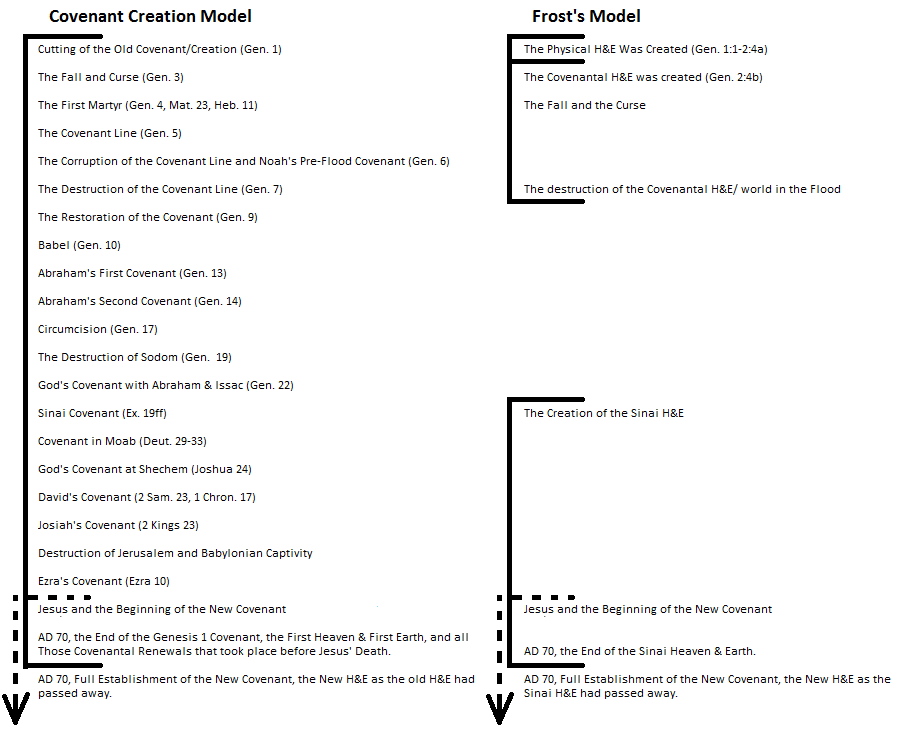
Frost's view was presented in his formal response to Beyond Creation Science released in 2008. His basic conclusion is that Genesis 1 describes the physical creation of the material universe. Genesis 2:4, according to Frost, is a "transition text" that switches subjects from the physical heavens and earth created "in the beginning" and a covenantal heaven and earth set up by God in the Garden of Eden. Thus, there are two different "heavens and earths" in the opening pages of the Bible. In Frost's words:
These two sentences [in Gen. 2:4] refer to two acts... the first sentence, as the NIV rightly notes, ends with “created” and refers back to the narrative of chapter 1. The second sentence looks forward...
2.4b starts another narrative, a narrative not about The Heavens and The Earth, but earth and heavens. It is an account of when God made an earth and a heavens distinct from The Earth and The Heavens. (p. 13)
Frost insists that Genesis 1 and 2 must be viewed as separate accounts, describing two different "heavens and earths" in large measure because of his understanding of 2 Peter 3:
There are two heavens and earths in the Genesis account, just as there must be two heavens and earths in Peter’s account. (p. 17)
Frost goes on to argue that it is this Gen. 2:4 "heavens and earth" that was destroyed by the flood, and that the "heavens and earth" in focus throughout NT eschatology is a third "heavens and earth" established at Sinai. The long-expected "New Heavens and New Earth" is the fourth "heavens and earth" in a multiple series of heavens and earth in biblical history (see p. 18).
In the end, Frost's model attempts to dichotomize Genesis 1 entirely from the purview of New Testament eschatology. This attempt, if successful, would serve to preserve a young-earth creationist reading of Genesis creation (as related to a literal description of the origin of the physical universe) while making room for a covenant "end" that has nothing to do with the end of our planet Earth and the physical universe. Frost's notion of multiple, separate "heavens and earths," parsed from the biblical text, concludes that the subject of the "beginning" in the Bible is completely different than the subject of the "end" in the Bible. This approach conflicts with the premise of Covenant Creation, as presented in Beyond Creation Science, which argues that the "beginning" and "end" are intimately related.
Martin and Vaughn Respond
Late in 2008, just a few weeks after Frost released his paper, we published a complete response to Frost's critique. We noted that Frost had presented a "partial-covenant creation" view. We also pointed out how Frost's objection to Covenant Creation, essentially, is that it is covenantalism “applied too much” or “taken to an extreme.”
Our article showed, on textual grounds, how Frost's dichotomy between two "heavens and earths" (in Genesis 1 and 2, respectively, based on a supposed "transition text" in Gen. 2:4) simply cannot work. Another key point in our response was that the Tabernacle/Temple motif Frost applied to the garden (Gen. 2:4ff) is inseparable from the clear covenant context of Genesis 1:
If the Tabernacle/Temple is the background, then Frost has a major problem. The architecture of the Tabernacle/Temple included the sea! Yet there is no sea in Genesis 2. Where is the background of the sea in Genesis creation? That background is found only in Genesis 1 which tells us about God’s creation of the sea and creatures of the sea.
What Frost has missed with his model is that the contrast between Genesis 1 and 2 is not between two separate heavens and earths, the physical universe and the covenantal heavens and earth in some sort of partial Covenant Creation scheme. Both creation texts relate to the one “heavens and earth” of God’s creation from two perspectives. Genesis 1 corresponds to the outer courts of the Tabernacle/Temple, including symbolism related to the Gentiles (hence the use of Elohim), whereas Genesis 2 is focused on the inner court and holy of holies, correlating to the Garden (hence the use of Yahweh). The Tabernacle/Temple motif lies not merely behind Genesis 2; it also lies behind Genesis 1...
By suggesting that the Tabernacle/Temple is the background of creation in Genesis 2, Frost has unwittingly affirmed the full Covenant Creation view. His partial Covenant Creation view (applied only to Gen. 2:4b-ff) is impossible because it presents only one segment of the Tabernacle/Temple scene, the inner courts and holy of holies. Genesis 1 completes the full picture. Here we find the sea (corresponding to the outer courts of the Gentiles); this is the “big picture” of the worship system (involving animal sacrifices, etc.) that God ordained for the entire old covenant age, the old covenant creation.
We also showed how another major problem for Frost's model includes the fact that many prophetic texts across the pages of Scripture reference detail in Genesis 1 within an eschatological context:
All of creation is covenantal. The prophets and apostles made no distinction between two supposed “heavens and earths” in Genesis. The details of Genesis 1 and 2 are both referenced as covenant context in such passages as Deuteronomy. 32:1, 10-11, Isaiah 51:13-16, and Jeremiah 4:23ff (see BCS pp. 328-330). Only the full Covenant Creation view can explain the sea-context so prominent at key points like Revelation 20:13 and 21:1. What Genesis 1-3 does, Revelation 20-22 undoes, because God created “a new heaven and new earth for the first heaven and the first earth had passed away. Also there was no more sea” (Rev. 21:1 NJK). The entire old creation was dissolved at the consummation, the full manifestation of the new creation. Covenant Eschatology demands Covenant Creation.
Another problem is that Frost overlooked the detail drawn from Genesis 1 as presented by 2 Peter 3. This citation from our response lays key groundwork for Jerel's paper below:
Note how [2 Peter 3:5] speaks of the existence of the heavens and the forming of the earth [ge] out of water which alludes to Gen. 1:9-10. Peter references the first heavens and the first earth of Scripture. Consider what Peter says next. By these waters the kosmos, the “governing order” or “arrangement,” was destroyed. Nothing is said about the heavens being destroyed. The Greek words for earth [ge] and world [kosmos] are different words entirely! Peter refers back to the corrupt “ancient world” he mentioned back in 2 Peter 2:5 “… bringing in the flood on the world [kosmos] of the ungodly.” Nowhere does Peter say that the flood destroyed “a” heaven and earth as Frost and some other preterist critics claim, but rather the waters destroyed the “world” or governing order of that time. The flood destroyed a wicked system of men who apostatized from the covenant faith, not a physical garden where no one lived. We presented this context of the flood in BCS as the line of Seth (Gen. 5) who “began to call on the name of the Lord” (Gen. 4:25). The covenant people had become corrupt (like the Jews in the first century) with the exception of righteous Noah. The wicked, not the old heavens and old earth, were destroyed by the flood.
The heavens and earth of 2 Peter 3:5 (reaching back into Genesis 1) is a reference to the entire old covenant creation. The old heavens and earth existed before the flood as well as after the flood. Animal sacrifices were accepted as the ordained way to worship God back in Genesis 4. Abel offered sacrifices from “the firstborn of his flock” (Gen. 4:4) just as Israel was required by the Law (Deut. 12:6). Clean and unclean distinctions were made before the flood (Gen. 7:2) as well as after. The seventh-day Sabbath is rooted in Genesis creation (Ex. 20:11). Yet all of this was reserved for destruction by fire at the end of the old covenant age, the termination of the entire old creation. We sometimes forget that Peter lived in the same old covenant creation as Abel. The New Testament demonstrates over and over how Jesus and the apostles viewed the coming end as the terminus of what began in the earliest chapters of Genesis (e.g., Matt. 23:35; Heb. 12:24). Peter says the world [kosmos] of the ungodly was destroyed by water in Noah’s day, but the heavens and earth [ge] were, at that time, reserved for fire.
A Pictorial Chart of the Debate
We have prepared this chart below to help the audience fully understand the contrast between the two positions in this debate:
The Fallout
Our response raised many other theological issues spawned by Frost's framework. At that time in 2008, we looked forward to further interaction with Frost concerning these issues. Perhaps there were answers to the problems we raised. Perhaps our cross-examination of Frost's model had refuted his partial-covenant creation model. We looked forward to further investigation.
Before our response was released in public, we received a commitment from Frost to continue the discussion for a total of three rounds of written interaction (see here and here). However, as of more than one year later no written response has been offered. To date, Frost has not followed up on his promised 2nd and 3rd installments of the discussion. Many issues have been relegated to various preterist discussion forum and debate sites or were simply dropped.
More recently, as Jerel mentions in his work below, Frost has engaged in a number of podcasts directed against the Covenant Creation view. Frost makes repeated claims in these recordings (and recent forum posts) about how he has "refuted" Covenant Creation based on the text of 2 Peter 3.
Jerel's article is a further refined, formal response to those bold claims. It extends many details and points we presented in our initial response to Frost's critique. In light of the scholarly detail in this paper (as well as our formal response of 2008), we now publicly appeal to Frost to deal, in print, with the biblical issues raised. We have responded to your concerns. We have dealt with your objections. Now it is high time that you respond to ours.
The time for running from internet website to internet website in order to make random potshots at Covenant Creation is over.
"Theologians sometimes use 'Old Covenant' to refer to the Mosaic covenant. There is truth to this in that the Mosaic covenant published most fully the distinctive character of the Adamic covenant under curse. Yet, ultimately, the Old Covenant is the covenant of the original garden of Eden. Ultimately there are two covenants, Old and New. There are two Adams, Adam and Jesus. There are two heavens and earth, the first in Adam and the second in Christ."
James B. Jordan, Through New Eyes (1988), p. 311.
The "then world" versus the "now heavens and earth" in 2 Peter 3:6-7
By Jerel Kratt
January 12, 2010
Introduction
This paper refutes Sam Frost’s position that Peter uses “heavens and earth” and “world” synonymously in 2 Peter 3:6-7. Such a position is critical to Frost’s rebuttal of the basic premise proposed by Tim Martin and Jeff Vaughn, authors of “Beyond Creation Science” (BCS), that the Heavens and Earth to be destroyed in AD 70 was the original creation of Genesis 1:1. Frost’s position is that the “heavens and earth” which were destroyed in AD 70 began at Sinai, and that there existed a previous covenantal “heavens and earth” beginning in Genesis 2:4 and ending with the flood of Noah. According to Frost, neither one of these previous “heavens and earth” had anything to do with the first “heavens and earth” mentioned in Genesis 1:1. That one, he claims, is the physical universe. I have respect for Mr. Frost, and my critique of his position does not mean he is not my brother in Christ and shall not receive my brotherly love. However, the ramifications of my paper are significant, for I believe it will prove that he is wrong on this issue.
My proposition is that the heavens and earth destroyed in 2 Peter 3 are not ones “created” at Sinai (Exodus 19), but rather they are the very same ones we find “in the beginning” (Genesis 1). I plan to show this by: (1) looking at the Greek text of 2 Peter 3, specifically analyzing the adverb “now” in verse 7 and the imperfect verb “were” in verse 5; (2) presenting the context of 2 Peter 3 as it relates to Peter’s argument and line of reasoning; and (3) by presenting a theological analysis of Scripture and the “true preterist” view as it relates to the full significance of the Parousia event in AD 70, reaching beyond the Sinai covenant and extending all the way to “the beginning” in Genesis...
Click here to read entire article
Concluding Comments
We thank Jerel Kratt for the hard work and care in accurately handling God's Word demonstrated by this article. We look forward to even more thought-provoking material to come in the future.
We would also like to add a few additional items for the audience to ponder as they investigate the issues at stake in this debate:
- Various forms of futurism divorce New Testament eschatology from the story of and promises given to Israel. Don Preston and many other preterist writers have shown this to be a great error that will inevitably confound the true meaning of biblical eschatology. But if it is invalid to divorce Israel from New Testament eschatology and the "end," then why would it be acceptable for preterists to divorce Israel (post Sinai) from creation and "the beginning" including all covenant history that takes place before Sinai? Frost's model delineates Sinai as a "new" heaven and earth that is disconnected from the pre-Exodus story. This divorces Israel from Genesis and the stories that go back to the opening pages of the Bible, including Abraham, Noah, and Adam! Is it logically coherent to divorce Israel from "the beginning," and yet stand against the very same practice engaged by the futurist who divorces Israel from "the end"?
- Paul says the Law (speaking of Sinai) was "added" (Gal. 3:19); added to what, if not added to the already-existing old covenant which already contained covenant promises including the inheritance (Gal 3:18). In that same text, Paul explicitly states that the Law, added 430 years later, does not set aside the covenant previously established (Gal. 3:17). How can Paul's teaching be squared with Frost's notion that Sinai is an entirely new "heavens and earth," an entirely new "creation," set apart from previous Old Covenant history? Doesn't Frost's model explicitly tear asunder (Exodus from Genesis) what Paul insists must remain joined together (promise and Law) in covenant unity?
- One of the many terrible implications of Frost's model is that the promises God gave to Adam in Gen. 3:15, to Abraham and the other ancients later in Genesis were not fulfilled when their respective "heavens and earth" ended. According to Frost, for example, Adam and Eve's "heaven and earth" passed away at the time of Noah's flood. Yet the promise given to Adam and Eve in Gen. 3:15 was not fulfilled until the coming of Christ! Frost is forced to propose that pre-Sinai covenant promises (including Gen. 3:15) were transferred from one "heavens and earth" to the succeeding "heavens and earth." But if that is the case, then what theological basis can the true preterist argue against those futurists who transfer the promise of resurrection from Old Covenant Israel to the New Covenant Church? These futurists have simply utilized Frost's methodology! For all practical purposes, Frost's model nullifies a key argument for the true preterist view of resurrection. If covenant promises can (and indeed were!!) transferred from one "heavens and earth" to the next, then why should we not expect the promise of resurrection (rooted in Gen. 3:15 and later re-iterated to Israel) be fulfilled in a "new heavens and new earth." Doesn't Frost's approach set the precedent for transferring God's covenant promises from one "heavens and earth" to the next "heavens and earth" as the pattern of Scripture from the very beginning of the Bible?
- The popular understanding of what God created "in the beginning" determines the nature of eschatological expectations and, consequently, futurist conclusions. That is why a proper understanding of Genesis as Covenant Creation is absolutely critical to the future of true preterism. We see this, for example, with "the death" that began in the Garden and is the focus of redemption "in Christ." If the nature of "the death" must be maintained consistently, from beginning to end, then shouldn't the nature of "creation" and "new creation" be maintained consistently from beginning to end?
- All forms of futurism in Christian theology are ultimately rooted in a physical-universe view of Genesis 1 creation. Doesn't Frost's approach to creation reinforce and retrench the ultimate root of futurism -- an ostensible physical universe creation as the "first thing" of concern in our Bible?
- Are animal sacrifices a constituent element of the old covenant? Wouldn't the pattern of animal sacrifice we read about in Genesis 3 and Genesis 4 identify that the old covenant world pre-dated both Moses and Abraham?
- If the "first heaven and earth" began with Moses (or Abraham?), then what is the covenant/legal basis for Jesus to claim to the Pharisees and teachers of the law that "on you may come all the righteous blood shed on the earth, from the blood of righteous Abel to the blood of Zechariah, son of Berechiah, whom you murdered between the temple and the alta" (Matt. 23:35). If the old covenant judgment on Israel avenged Abel's blood upon that wicked generation, wouldn't that demonstrate that the old covenant age includes Abel, long before Moses and Abraham? How could the Pharisees and teachers of the law be covenantally responsible for the blood of Abel if they lived in an entirely different covenant world than Abel and all the rest of early Genesis? (See also Hebrews 11:4).
Now we will wait for Frost to address these points in print. Our last comment is an appeal to our audience. Please consider the details Frost supplies in any forthcoming response.
Judge for yourself. Does Frost deal with the specific biblical arguments we presented in 2008 and Jerel presents in this article? Does Frost even discuss our biblical arguments? Or, does Frost spend his efforts on matters of philosophy and science? Note how there are no scientific arguments in our response to Frost or in Jerel's article. If Frost wants to spend vast tracts of his writing on issues of philosophy and science, then he is avoiding the central matter at hand. We have made a biblical case for Covenant Creation from the text of Scripture.
We have long suspected that matters of philosophy and science are of greater importance to Frost than any biblical argument about Genesis. Is that a valid charge? There is only one way to find out. Examine Frost's material for yourself and evaluate it based on the subjects and details he addresses and the subjects and details he conveniently ignores.
We thank you for your time and hope that you contemplate all of these issues carefully in the light of God's Word.
Blessings,
Tim Martin and Jeff Vaughn
co-authors, Beyond Creation Science
Jerel Kratt's Response to Samuel Frost on 2 Peter 3
January 19, 2010
Samuel Frost has agreed to continue the discussion with Jerel Kratt. We offer his reponse to Jerel's article below and will add further developments as they become available:
The reader should consider at this point what Samuel Frost previously taught regarding 2 Peter 3 in his 2002 book titled Misplaced Hope:
"The conflagration language lent itself to a literal interpretation as well as Paul's resurrection language. But for Paul, as well as John, speaking of the 'land being removed' and the 'elements melting' was nothing more than a heavenly convulsion of universal and cosmic proportions that even the true physical destruction of the world in Noah's day could not pull off: salvation over sin and death and sin, and redemption of humankind by entrance through the cosmic body of the Logos into a new and living way of life, the resurrection from the dead." (emphasis ours)
Misplaced Hope, pp. 120-121, (2002, 2006)
It seems quite ironic that Sam Frost was arguing Jerel Kratt's view as early as 2002, years before being confronted with the implications which lead directly to Covenant Creation.
February 7, 2010
Jerel offers further discussion regarding Frost's multiple-heavens-and-earths model.
January 29, 2010
Why Doesn't Sam Frost apply his rules for apocalyptic genre consistently? What happens when a critic turns Sam Frost's argument against Beyond Creation Science into an argument against Covenant Eschatology?
Sam, 1 Cor. 14 and 1 Thess. 4 Apocalyptic Genre?
December 13, 2010
Sam Frost explains how his young-earth creationist beliefs drive his new approach to eschatology:
"Now, the gauntlet has been thrown down: if Genesis is talking about physical creation, you cannot be a Full Preterist. You MUST accept this or, you will end up like me. I think he [Tim Martin] may have a point here…
Martin is correct here about what has forced much (not all) of my recent moves. There are some things when I became a Full Preterist (1992) that I would not, and have not, given up…..Full Preterism means this: YOU HAVE TO GIVE UP A WHOLE HELL OF A LOT."
Tim Martin's Warning
December 17, 2010
Samuel Frost abandons Full Preterism due to his ultimate committment to young-earth, physical-universe creationism:
"The Full Preterist believes that all is right with the world entirely in a spiritual reality and has absolutely nothing to do with any type of renovation of the earth or the end of human history as it now is...
The creation being subjected to vanity brings us back to the Genesis 3 line of thought that 8.19-ff is culminating, which began in 5.12-ff. The phrase “vanity” (only used here in Romans) is the same word in Ecclesiastes referring to life in general. Things are not what they should be. Again, virtually every commentary sees Paul here as refering to Genesis 3 and hinting at the protoevangelion of 3.15: the arrival of the Son of God, the Seed of the woman, satan’s head will “soon be crushed” (Rom 16:20).
I am forced, then, to reevaluate my stance on Rom 8.19-ff based on the overwhelming observations of the critical scholars on this text... Paul’s argument in 8 began in 5.12-ff. This is where “the sin” and “the death” came into “the world”. This is where cursings upon creation itself came into the world as a result of sin. This is where God’s wrath came upon the creation as a result of Man’s disobedience...
I also affirm that history will, one day, like ourselves, come to a “natural end.” Our lives will end, so it is natural to think that the earth will one day expire, too (and the Bible says it will in a few places). But, since “the creation” is so connected with the events of salvation, as I have argued covenantally, above, then it is natural, along with N.T. Wright and, for the most part, Christian orthodoxy, that “the creation” itself will ultimately manifest and realize that great prayer of Jesus: on earth as it is in heaven. At the end of history, whenever that is we know not (Eccl 3.11), all things will be realizing the salvation of God. The Creation itself will come into its ultimate – never before realized – Purpose. And, as God’s people, we shall enjoy it forever."
Romans 8:19-ff: Covenant Blessings
... Martin then goes on the attack again concerning young earth creationism, but there are some fine points in these pages. The real shocker comes on page 435. “The Christian goal for missions must be nothing less than the complete conversion and evangelization of our planet through the gospel of Jesus Christ! (ital. his). Wow. Simply, wow! Amen, Mr. Martin. “Preterism provides a theological framework and time perspective necessary for the accomplishment of an amazing goal – the conversion of our entire planet Earth to Christ by the power of the Christian gospel” (435). Gary DeMar could not have written this better. This is postmillennialism 101.
But, when I use words like “end” or “goal” I get hammered by Sullivan and Green. Let me be clear here: The goal you have just read from the pen of Tim Martin is EXACTLY my goal. But, and let this sink in deep, if this goal is so amazing, so damn-near-hard-to-imagine, but yet will be realized (manifested), then wouldn’t you think the Bible would say something about it? What, this Great Goal of the effects of Christ’s Cross and Parousia are not mentioned in the Prophets? Huh? I am so glad I re-read this chapter. Please, again, accept my apology Tim, Jeff (and Tami) for speaking falsely of Covenant Creationism and having no goal…….no future…..you certainly do!...
So, again, read this post – read that chapter. Martin’s goal is my goal. I suppose the difference is that I believe that this goal is prophesied. Once it is accomplished perhaps then God will end history. I don’t know when He will, just that he has revealed in the Bible that he will (Eccl 3.11; Is 41.4, et al). Other than these points, Martin and I are two peas in a pod. Of course, Martin will probably claim that the only way you can get to this goal is to accept his covenant creationism. Nah. I’ll stick with the embarassment of believing in a young earth...
Sam Frost
... I don't know how to break this to you, but you don't have a clue about what we actually said in Chapter 21. I appreciate your positive comments on the chapter. The problem is that you read the chapter with your own mindset and definitions jangling so loudly in your own head that you simply forced your own conceptions on what we actually wrote. I have seen this pattern with you over and over. Whenever you read someone, you can only see how that particular author is "saying the same things" as Sam Frost. This is what happened once again. Your evaluation of chapter 21? Not even close.
First, notice the first sentence below the "Conclusion" on p. 417 in the previous chapter: "Our case for the complete fulfillment of prophecy, based on the testimony of many biblical witnesses, will lead naturally to many questions about what that means for modern Christians today." That's the immediate context before chapter 21. We presented the "complete fulfillment" of prophecy. Habakukk 2:14? Fulfilled. That is because the "land/earth" in that text is the new covenant. It is a prophecy about the coming new covenant. The knowledge of the glory of the Lord is known by believers who inhabit the new heavens and new earth "as the waters cover the sea." Fulfilled. That is why no one needs to teach his neighbor to "know the Lord," because they all know the Lord, from the least to the greatest (Jer. 31:34). Jer. 31:34 is fulfilled in the new covenant "heavens and earth." Everyone in the new covenant knows God. Fulfilled. How about Isaiah 11:9: "They will neither harm nor destroy on all my holy mountain, for the earth will be filled with the knowledge of the LORD as the waters cover the sea"? Fulfilled. Notice the connection between the Holy Mountain and the earth in that passage.Just like Jerusalem and the new heavens and new earth in Rev. 21-22. Isaiah 11:10 (the very next verse) has an explicit time statement "In that day..." for goodness sake.
I, personally, am awaiting no OT prophecy to be fulfilled. All of God's promises are fulfilled in Christ. Jeff and I said that explicitly in the previous chapter.
Secondly, the part in BCS you erroneously cite is this: "The Christian goal for missions must be nothing less than the complete conversion and evangelization of our planet through the gospel of Jesus Christ!" (BCS p. 435)
You read the word "goal" as in the sense of "telos" or "ultimate destination" because that is what you were thinking about at the time with your infinity discussion. Worse yet, you can't see any kind of statement like thas apart from your Postmillennialism. Notice, though, it is the "Christian goal." I put it that way not because we are fulfilling some kind of worldwide prophecy or that history has to come to an end when we reach this "consummation" point or whatever nonsense you were spouting at the time. This is the "Christian goal" because I happen to think Christians generally enjoy (or at least should!) sharing God with their neighbors. You seem to imply that if there is no prophecy regarding "planet Earth" then "why in the heck would we want to evangelize it"? (your words)
Seriously, you need to stop for a second and think about what you saying. It is idiotic. If the Bible doesn't have any prophecy regarding a global conversion of planet Earth, then Christians shouldn't want to evangelize their neighbors and share the knowledge of God with others?
Dude, you are losing your marbles.
Christians have a lot of interest to share God with others. Love of neighbor is the one that comes off the top of my head. And if it is good to share the gospel with my neighbors, then wouldn't it be even better to help play my part in sharing it with all of my neighbors? But there is even self-interest involved, too. The world is a better place where the gospel has been before, for everyone. And we human beings are going to live on this planet Earth indefinitely, in my view.
I happen to believe the gospel is powerful, and if you look again at the context (BCS p. 431-433) of the discussion, then you will see the whole discussion you are harping on was in terms of the historical example of the past success of the gospel in the first century which fulfilled the Great Commission. Do you believe the Great Commission has been fulfilled? We made this very, very clear in the book. None of this part of BCS was written in any way in the context of fulfilling OT prophecy. That is your hair-brained idea that currently so possesses you that you insert it directly into our presentation, and then bandy the whole thing about in your writing like we were jumping on your latest bandwagon. This would be funny if it weren't so pathetic.
Thirdly, even if Christians were ultimately successful with evangelizing the planet for Christ, there is no guarantee this would be a permanent or irreversible condition. I think you have the concept that once the gospel takes over a nation, it is permanent. Sort of like a national "once saved always saved" notion. Or perhaps a baptized theological Evolution theory, as if every step is always progress no matter what. However, things not only progress in history, they can regress as well. There is movement both ways in history at any given location and time. Always has been, always will be. I see no end to kingdom work in the future, regardless.
Consider Asia Minor. The gospel had magnificent growth in the first century, but how is the gospel doing there today? Think "Turkey." Does the name "Constantinople" ring a bell? What is that place called today? Why? Or how about North Africa. This is the place where Augustine lived and wrote! And yet there is hardly a shred of Christianity left in that land today. Why is this, and why couldn't this possibly happen even after wider expansion of the gospel in the future? I would go so far as to say that America is in decline today from its Christian roots. Would you even consider Europe "Christian" anymore?
These are the kinds of details that postmillennialists (usually Calvinists) don't talk about very much. If they do, they dismiss them as "setbacks." Yet even the postmillennialism I was taught from Gentry had the "pleasure" of awaiting the fulfillment of Rev. 20:7-10. It is such a stupid system, all things considered. Why anyone would want to marry Postmillennialism with Full-preterism is beyond me. Have you consulted the postmillennialists about your novel idea? I think most of them are happily married already... to voluptuous partial-preterism.
If you were smart, you would repudiate your recent lurch back into the wacky world of futurism and come back to your senses to work once again within Covenant Eschatology. After awhile hardly anyone would remember this blip in your writing history and those off the web with your books on their shelves would never be the wiser for it. Give up this nutty futurism. You've done a lot of great work in Covenant Eschatology and it saddens me to see you are well on your way to repudiating virtually all of your contributions to Full Preterism in the past. If you have difficult personal issues in the background, just take a break for some time to get your bearings. Talk to people like Don Preston. Rethink your committment to abstract philosophizing and theoretical speculation. Don't end your time with Full Preterism in such an ugly wreck.
As far as how the future will go on planet Earth? I don't know, and neither do you. I certainly don't believe the Bible was given to tell us about the end of planet Earth. Same principle applies to the original formation of our universe. (I do realize that this might mean admitting that we probably should have listened to those "evil" scientists a bit more in the past, but so what?) The Bible just doesn't tell us those things. Why would it? We have everything in Christ. With a little bit of work and some perseverance the future will be bright indeed. I see that fact worked out in the lives of individuals, families, congregations, and nations. It never ceases to amaze me.
I am optimistic because I think that historical paradigms (like the Reformed Faith) are disintegrating along with their incipient futurism. Now that is God working in history for you! But exactly what a new era of realized theology will fully entail and effect around us is beyond me. But here's an idea. What if God didn't say anything about the future so as not to spoil this grand adventure upon which he has embarked with his people? Ever thought of that? Adventure. Drama. Suspense. Sounds like the Kingdom of God to me. What if God is perfectly happy to enjoy the mature presence with his people living by faith? Why should we, in the maturity of the new covenant, have this "are we there, yet, are we there, yet, are we there, yet" mentality? Why should we go bonkers if God doesn't spell out the future in specific detail like we see in the context of the Old Covenant? Do you really want to emulate that structure and format?
I don't.
I like adventure. I am very grateful that my view calls for living into the future by faith. For now, I am perfectly content to live in the kingdom of God through covenant and work out the gospel in my life with my family, my congregation and my community.
Life is good.
Tim Martin
(source)
March 6, 2011
"... I submit that that if Full Preterism is correct, then I was wrong in insisting that Covenant Creationists have no case. I fought hard against them. But, it does appear to be the case, as reluctant as I was to admit it, that they may well be the future..."
Sam Frost
February 1, 2012
It appears this old debate has roared back to new life. Consider how this new article by Joel McDurmon from American Vision follows many of the precise details and conclusions argued previously by Sam Frost:
What makes this development significant is that Joel McDurmon is scheduled to debate Don Preston at the 2012 Preterist Pilgrim Weekend in Ardmore, OK. Watch for post-debate analysis later in 2012.
|