| Click here to read Beyond Creation Science: New Covenant Creation from Genesis to Revelation
Critical Review by:
Sam Frost, Author and Conference Speaker
October 26, 2008
"The following article will be a bit technical, but I will try to explain definitions as best I can as I go along. This response to an issue that has been clouding up the horizon, in my opinion, for some time and has not yet been adequately answered from a Biblical Preterist perspective..."
Click Here for Entire Review
Click Here for Response by Tim and Jeff
Click Here for Response by Jerel Kratt (2 Peter 3 Article)
Click Here for the 2026 Mike Sullivan Debate (Isaiah 51:15-16)
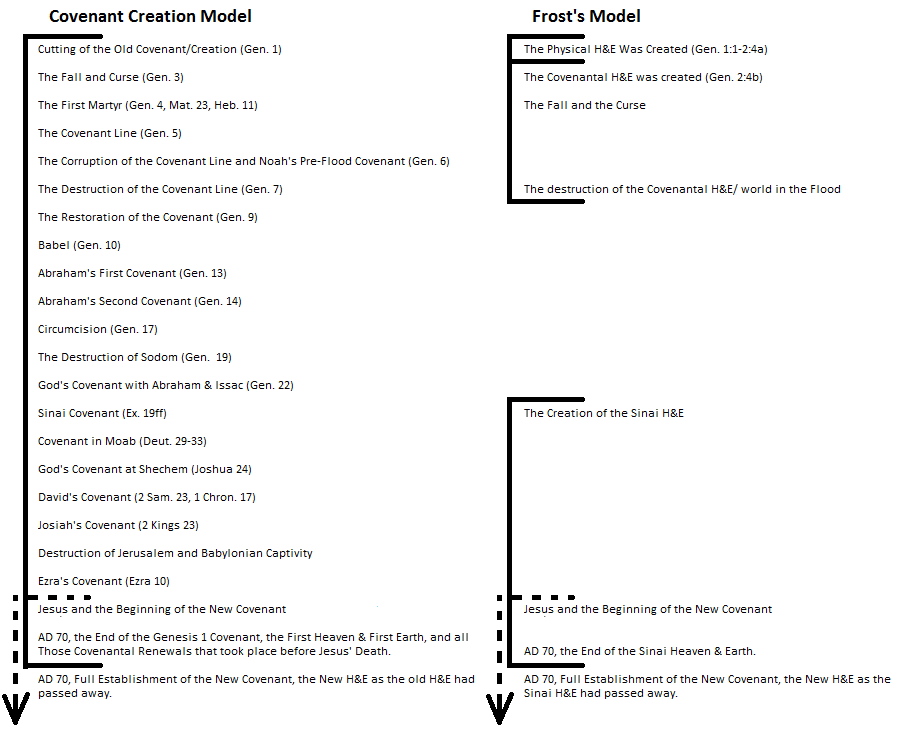
The reader should consider at this point what Samuel Frost previously taught regarding 2 Peter 3 in his 2002 book titled Misplaced Hope:
"The conflagration language lent itself to a literal interpretation as well as Paul's resurrection language. But for Paul, as well as John, speaking of the 'land being removed' and the 'elements melting' was nothing more than a heavenly convulsion of universal and cosmic proportions that even the true physical destruction of the world in Noah's day could not pull off: salvation over sin and death, and redemption of humankind by entrance through the cosmic body of the Logos into a new and living way of life, the resurrection from the dead." (emphasis ours)
Misplaced Hope, pp. 120-121, (2002, 2006)
Here is what Gordon Clark taught on the age of the universe and biblical doctrine of creation:
Gordon Clark on the age of the universe and creation
"Theologians sometimes use 'Old Covenant' to refer to the Mosaic covenant. There is truth to this in that the Mosaic covenant published most fully the distinctive character of the Adamic covenant under curse. Yet, ultimately, the Old Covenant is the covenant of the original garden of Eden. Ultimately there are two covenants, Old and New. There are two Adams, Adam and Jesus. There are two heavens and earth, the first in Adam and the second in Christ."
James B. Jordan, Through New Eyes (1988), p. 311.
Debate PostScript and Follow-up Discussion
December 13, 2010
Sam Frost explains how his young-earth creationist beliefs drive his new approach to eschatology:
"Now, the gauntlet has been thrown down: if Genesis is talking about physical creation, you cannot be a Full Preterist. You MUST accept this or, you will end up like me. I think he [Tim Martin] may have a point here…
Martin is correct here about what has forced much (not all) of my recent moves. There are some things when I became a Full Preterist (1992) that I would not, and have not, given up…..Full Preterism means this: YOU HAVE TO GIVE UP A WHOLE HELL OF A LOT."
2025 Clip of Sam Frost explaining the incompatibility of Young Earth Preterism
Tim Martin's Warning
December 17, 2010
Samuel Frost abandons Full Preterism due to his ultimate committment to young-earth, physical-universe creationism:
"The Full Preterist believes that all is right with the world entirely in a spiritual reality and has absolutely nothing to do with any type of renovation of the earth or the end of human history as it now is...
The creation being subjected to vanity brings us back to the Genesis 3 line of thought that 8.19-ff is culminating, which began in 5.12-ff. The phrase “vanity” (only used here in Romans) is the same word in Ecclesiastes referring to life in general. Things are not what they should be. Again, virtually every commentary sees Paul here as refering to Genesis 3 and hinting at the protoevangelion of 3.15: the arrival of the Son of God, the Seed of the woman, satan’s head will “soon be crushed” (Rom 16:20).
I am forced, then, to reevaluate my stance on Rom 8.19-ff based on the overwhelming observations of the critical scholars on this text... Paul’s argument in 8 began in 5.12-ff. This is where “the sin” and “the death” came into “the world”. This is where cursings upon creation itself came into the world as a result of sin. This is where God’s wrath came upon the creation as a result of Man’s disobedience...
I also affirm that history will, one day, like ourselves, come to a “natural end.” Our lives will end, so it is natural to think that the earth will one day expire, too (and the Bible says it will in a few places). But, since “the creation” is so connected with the events of salvation, as I have argued covenantally, above, then it is natural, along with N.T. Wright and, for the most part, Christian orthodoxy, that “the creation” itself will ultimately manifest and realize that great prayer of Jesus: on earth as it is in heaven. At the end of history, whenever that is we know not (Eccl 3.11), all things will be realizing the salvation of God. The Creation itself will come into its ultimate – never before realized – Purpose. And, as God’s people, we shall enjoy it forever."
Romans 8:19-ff: Covenant Blessings
... Martin then goes on the attack again concerning young earth creationism, but there are some fine points in these pages. The real shocker comes on page 435. “The Christian goal for missions must be nothing less than the complete conversion and evangelization of our planet through the gospel of Jesus Christ! (ital. his). Wow. Simply, wow! Amen, Mr. Martin. “Preterism provides a theological framework and time perspective necessary for the accomplishment of an amazing goal – the conversion of our entire planet Earth to Christ by the power of the Christian gospel” (435). Gary DeMar could not have written this better. This is postmillennialism 101.
But, when I use words like “end” or “goal” I get hammered by Sullivan and Green. Let me be clear here: The goal you have just read from the pen of Tim Martin is EXACTLY my goal. But, and let this sink in deep, if this goal is so amazing, so damn-near-hard-to-imagine, but yet will be realized (manifested), then wouldn’t you think the Bible would say something about it? What, this Great Goal of the effects of Christ’s Cross and Parousia are not mentioned in the Prophets? Huh? I am so glad I re-read this chapter. Please, again, accept my apology Tim, Jeff (and Tami) for speaking falsely of Covenant Creationism and having no goal…….no future…..you certainly do!...
So, again, read this post – read that chapter. Martin’s goal is my goal. I suppose the difference is that I believe that this goal is prophesied. Once it is accomplished perhaps then God will end history. I don’t know when He will, just that he has revealed in the Bible that he will (Eccl 3.11; Is 41.4, et al). Other than these points, Martin and I are two peas in a pod. Of course, Martin will probably claim that the only way you can get to this goal is to accept his covenant creationism. Nah. I’ll stick with the embarassment of believing in a young earth...
Sam Frost
... I don't know how to break this to you, but you don't have a clue about what we actually said in Chapter 21. I appreciate your positive comments on the chapter. The problem is that you read the chapter with your own mindset and definitions jangling so loudly in your own head that you simply forced your own conceptions on what we actually wrote. I have seen this pattern with you over and over. Whenever you read someone, you can only see how that particular author is "saying the same things" as Sam Frost. This is what happened once again. Your evaluation of chapter 21? Not even close.
First, notice the first sentence below the "Conclusion" on p. 417 in the previous chapter: "Our case for the complete fulfillment of prophecy, based on the testimony of many biblical witnesses, will lead naturally to many questions about what that means for modern Christians today." That's the immediate context before chapter 21. We presented the "complete fulfillment" of prophecy. Habakukk 2:14? Fulfilled. That is because the "land/earth" in that text is the new covenant. It is a prophecy about the coming new covenant. The knowledge of the glory of the Lord is known by believers who inhabit the new heavens and new earth "as the waters cover the sea." Fulfilled. That is why no one needs to teach his neighbor to "know the Lord," because they all know the Lord, from the least to the greatest (Jer. 31:34). Jer. 31:34 is fulfilled in the new covenant "heavens and earth." Everyone in the new covenant knows God. Fulfilled. How about Isaiah 11:9: "They will neither harm nor destroy on all my holy mountain, for the earth will be filled with the knowledge of the LORD as the waters cover the sea"? Fulfilled. Notice the connection between the Holy Mountain and the earth in that passage.Just like Jerusalem and the new heavens and new earth in Rev. 21-22. Isaiah 11:10 (the very next verse) has an explicit time statement "In that day..." for goodness sake.
I, personally, am awaiting no OT prophecy to be fulfilled. All of God's promises are fulfilled in Christ. Jeff and I said that explicitly in the previous chapter.
Secondly, the part in BCS you erroneously cite is this: "The Christian goal for missions must be nothing less than the complete conversion and evangelization of our planet through the gospel of Jesus Christ!" (BCS p. 435)
You read the word "goal" as in the sense of "telos" or "ultimate destination" because that is what you were thinking about at the time with your infinity discussion. Worse yet, you can't see any kind of statement like thas apart from your Postmillennialism. Notice, though, it is the "Christian goal." I put it that way not because we are fulfilling some kind of worldwide prophecy or that history has to come to an end when we reach this "consummation" point or whatever nonsense you were spouting at the time. This is the "Christian goal" because I happen to think Christians generally enjoy (or at least should!) sharing God with their neighbors. You seem to imply that if there is no prophecy regarding "planet Earth" then "why in the heck would we want to evangelize it"? (your words)
Seriously, you need to stop for a second and think about what you saying. It is idiotic. If the Bible doesn't have any prophecy regarding a global conversion of planet Earth, then Christians shouldn't want to evangelize their neighbors and share the knowledge of God with others?
Dude, you are losing your marbles.
Christians have a lot of interest to share God with others. Love of neighbor is the one that comes off the top of my head. And if it is good to share the gospel with my neighbors, then wouldn't it be even better to help play my part in sharing it with all of my neighbors? But there is even self-interest involved, too. The world is a better place where the gospel has been before, for everyone. And we human beings are going to live on this planet Earth indefinitely, in my view.
I happen to believe the gospel is powerful, and if you look again at the context (BCS p. 431-433) of the discussion, then you will see the whole discussion you are harping on was in terms of the historical example of the past success of the gospel in the first century which fulfilled the Great Commission. Do you believe the Great Commission has been fulfilled? We made this very, very clear in the book. None of this part of BCS was written in any way in the context of fulfilling OT prophecy. That is your hair-brained idea that currently so possesses you that you insert it directly into our presentation, and then bandy the whole thing about in your writing like we were jumping on your latest bandwagon. This would be funny if it weren't so pathetic.
Thirdly, even if Christians were ultimately successful with evangelizing the planet for Christ, there is no guarantee this would be a permanent or irreversible condition. I think you have the concept that once the gospel takes over a nation, it is permanent. Sort of like a national "once saved always saved" notion. Or perhaps a baptized theological Evolution theory, as if every step is always progress no matter what. However, things not only progress in history, they can regress as well. There is movement both ways in history at any given location and time. Always has been, always will be. I see no end to kingdom work in the future, regardless.
Consider Asia Minor. The gospel had magnificent growth in the first century, but how is the gospel doing there today? Think "Turkey." Does the name "Constantinople" ring a bell? What is that place called today? Why? Or how about North Africa. This is the place where Augustine lived and wrote! And yet there is hardly a shred of Christianity left in that land today. Why is this, and why couldn't this possibly happen even after wider expansion of the gospel in the future? I would go so far as to say that America is in decline today from its Christian roots. Would you even consider Europe "Christian" anymore?
These are the kinds of details that postmillennialists (usually Calvinists) don't talk about very much. If they do, they dismiss them as "setbacks." Yet even the postmillennialism I was taught from Gentry had the "pleasure" of awaiting the fulfillment of Rev. 20:7-10. It is such a stupid system, all things considered. Why anyone would want to marry Postmillennialism with Full-preterism is beyond me. Have you consulted the postmillennialists about your novel idea? I think most of them are happily married already... to voluptuous partial-preterism.
If you were smart, you would repudiate your recent lurch back into the wacky world of futurism and come back to your senses to work once again within Covenant Eschatology. After awhile hardly anyone would remember this blip in your writing history and those off the web with your books on their shelves would never be the wiser for it. Give up this nutty futurism. You've done a lot of great work in Covenant Eschatology and it saddens me to see you are well on your way to repudiating virtually all of your contributions to Full Preterism in the past. If you have difficult personal issues in the background, just take a break for some time to get your bearings. Talk to people like Don Preston. Rethink your committment to abstract philosophizing and theoretical speculation. Don't end your time with Full Preterism in such an ugly wreck.
As far as how the future will go on planet Earth? I don't know, and neither do you. I certainly don't believe the Bible was given to tell us about the end of planet Earth. Same principle applies to the original formation of our universe. (I do realize that this might mean admitting that we probably should have listened to those "evil" scientists a bit more in the past, but so what?) The Bible just doesn't tell us those things. Why would it? We have everything in Christ. With a little bit of work and some perseverance the future will be bright indeed. I see that fact worked out in the lives of individuals, families, congregations, and nations. It never ceases to amaze me.
I am optimistic because I think that historical paradigms (like the Reformed Faith) are disintegrating along with their incipient futurism. Now that is God working in history for you! But exactly what a new era of realized theology will fully entail and effect around us is beyond me. But here's an idea. What if God didn't say anything about the future so as not to spoil this grand adventure upon which he has embarked with his people? Ever thought of that? Adventure. Drama. Suspense. Sounds like the Kingdom of God to me. What if God is perfectly happy to enjoy the mature presence with his people living by faith? Why should we, in the maturity of the new covenant, have this "are we there, yet, are we there, yet, are we there, yet" mentality? Why should we go bonkers if God doesn't spell out the future in specific detail like we see in the context of the Old Covenant? Do you really want to emulate that structure and format?
I don't.
I like adventure. I am very grateful that my view calls for living into the future by faith. For now, I am perfectly content to live in the kingdom of God through covenant and work out the gospel in my life with my family, my congregation and my community.
Life is good.
Tim Martin
(source)
March 6, 2011
"... I submit that that if Full Preterism is correct, then I was wrong in insisting that Covenant Creationists have no case. I fought hard against them. But, it does appear to be the case, as reluctant as I was to admit it, that they may well be the future..."
Sam Frost
UPDATE! December 10, 2025
I have been looking for this for over 20 years now.
What did Gordon Clark teach on Genesis creation?
This is sort of a niche question related some particular critics of Beyond Creation Science and Covenant Creation. These disciples of Gordon Clark saw BCS as a threat, for very good reasons.
This morning I tripped over this unearthed piece of obscure evidence. Turns out, Gordon Clark no only rejected young-earth creationism's claims... No, no. It's way better than that.
Gordon Clark, in fact, when discussing the issue of the age of the earth and doctrine of creation, offered a qualified recommendation to read Bernard Ramm's monumental book titled: "The Christian View of Science and Scripture"!
Get the power of this. Bernard Ramm's work was cited dozens of of times in Beyond Creation Science. His work is denounced by all the young-earth creationist organizations as "compromise" with Darwinism and Scientism.
Yet Gordon Clark recommended to read it for the case Ramm made!
Here is a brief description of Ramm's book:
"Acutely aware of the imperative necessity for a harmony of science with Scripture, Bernard Ramm here calls for the return of evangelicalism to the tradition of late nineteenth-century conservative scholars, who learned the facts of science and Scripture with patience, care and integrity, and showed with great competence and training that these two can never conflict."
Here is the article and statements related to Gordon Clark
|